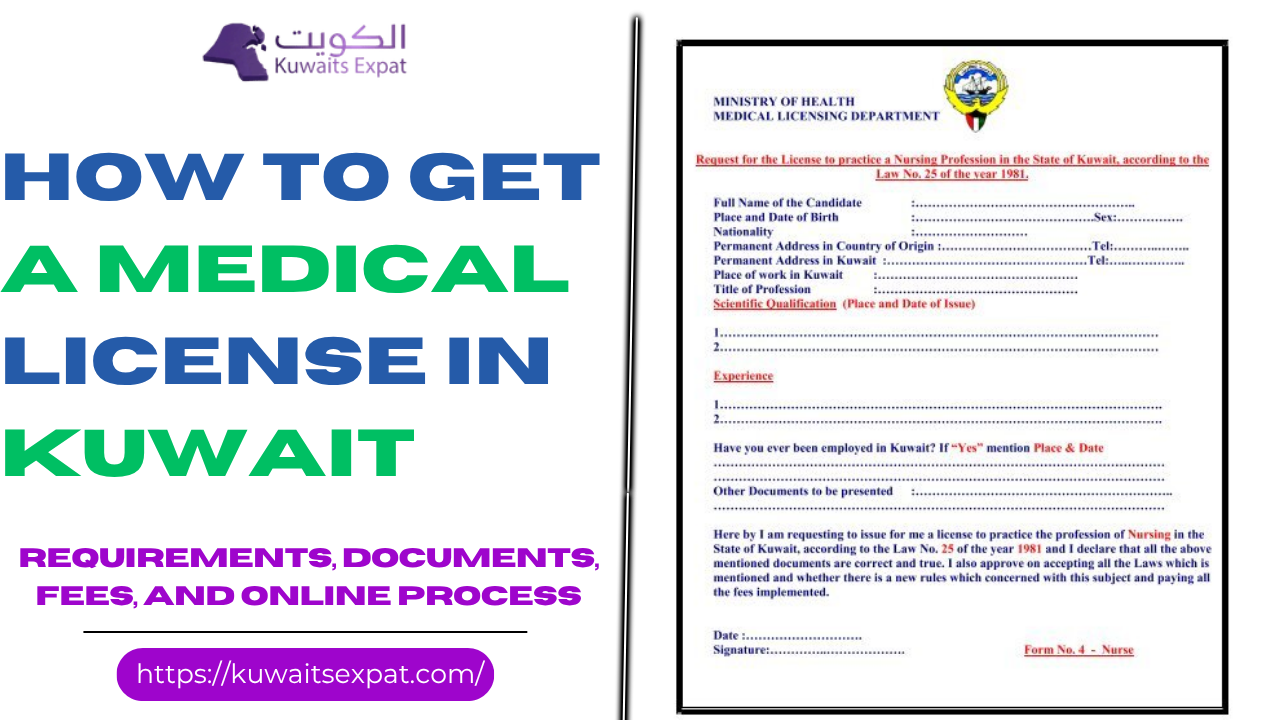
How to Get a Medical License in Kuwait: Requirements, Documents, Fees, and Online Process
I’m Saleh Muhammad, a Kuwaiti citizen, and I’ve been living outside Kuwait for over 10 years. During that time, I learned the hard way how Gulf paperwork really works, especially when it involves official approvals, attestations, and “one missing stamp” delays. In this guide, I’ll walk you through the Kuwait medical licensing process in a clear, practical way so you can move faster and avoid the common mistakes I’ve seen expats and Kuwaitis make.
A medical license in Kuwait is not optional. If you want to work as a doctor, dentist, nurse, pharmacist, or allied health professional in a clinic or hospital, you must be licensed by the Kuwait Ministry of Health (MOH).
Understanding the medical license system in Kuwait
Kuwait’s medical licensing system exists for one main reason: patient safety and quality control. The MOH checks that every healthcare professional is properly trained, qualified, and competent before allowing them to treat patients.
Why Kuwait requires a medical license
Here’s what MOH licensing protects:
- Patient safety: Only trained and verified professionals can practice.
- Credential verification: Degrees, training, and experience must be proven and authenticated.
- Workforce regulation: Hospitals and clinics are expected to employ licensed staff only.
- Legal compliance: Practicing without a valid license can lead to penalties, termination, and immigration issues.
From experience, the biggest misconception is this:
You might be fully licensed in your home country, but Kuwait still requires MOH approval before you can practice legally.
Types of medical licenses in Kuwait (2026)
Licensing categories depend on your profession and where you will work.
Main license categories (simple overview)
| License type | Who it is for | Typical workplace |
|---|---|---|
| Physician / Dentist license | Doctors, dentists, specialists | Government hospitals, private hospitals, clinics |
| Private sector practice eligibility | Licensed clinicians working under a private facility | Private hospitals, private clinics |
| Allied health professional license | Lab, radiology, physiotherapy, etc. | Hospitals, clinics, medical centers |
| Nursing and similar categories | Nurses and clinical support roles | Hospitals and clinics |
Your job title and professional level matter. MOH may classify you differently than your home country (for example, specialist vs registrar vs consultant level).
Kuwait medical license online application (2026): Step-by-step process
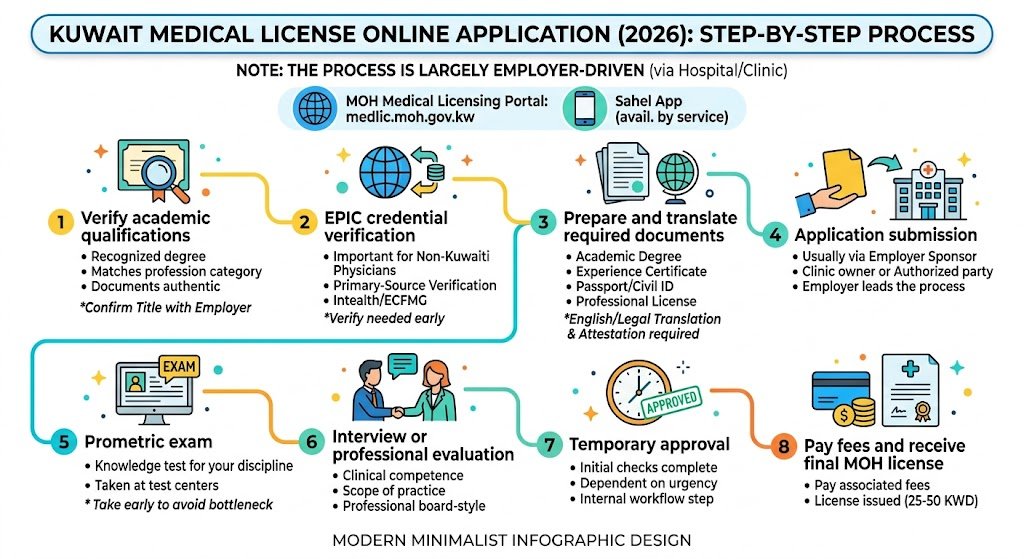
In most cases, your medical license file is handled through the hospital or clinic that is hiring you. Even when parts of the process are online, it’s usually still employer-driven.
At the time of writing (2026), Kuwait uses official MOH systems such as:
- MOH medical licensing portal: https://medlic.moh.gov.kw
- Sahel app (used for many government services in Kuwait; availability can vary by service/category)
If you’re an expat, expect that your employer’s HR or licensing officer will guide submissions.
Step 1: Verify your academic qualifications (before you do anything else)
Your degree and specialty must be recognized, and your documents must be authentic and properly attested.
In practice, “recognized” usually comes down to:
- Is your university legitimate and accredited?
- Does your degree match the profession category you’re applying under?
- Can the documents be confirmed through official channels?
My advice: before you pay for translations, flights, or exams, ask your employer (or licensing contact) which exact professional title MOH will apply to you.
Step 2: EPIC credential verification (important for non-Kuwaiti physicians)
Since late 2018, many non-Kuwaiti physicians whose basic medical qualification was obtained outside Kuwait may need EPIC verification:
- EPIC: Electronic Portfolio of International Credentials
- Managed by ECFMG / Intealth
- Purpose: primary-source verification directly with the issuing institution
Why EPIC matters: It can be the longest step if your university is slow to respond.
Some categories or cases may be exempt (for example, specific temporary arrangements or if credentials were already verified through an approved pathway). If you’re unsure, confirm directly with MOH licensing:
- Email: license@moh.gov.kw
Step 3: Prepare the required documents (and get them translated correctly)
This is where most delays happen. You need the right documents, in the right format, with the right stamps.
Common required documents (core set)
| Document | Why it is required |
|---|---|
| Academic degree(s) + transcripts | Proves your education and eligibility |
| Professional license / registration from home country | Proves you are/were legally allowed to practice |
| Experience certificate(s) | Confirms employment history and clinical practice |
| Passport copy and/or Civil ID (if available) | Identity verification |
| Recent personal photo | Official MOH records |
| Professional membership confirmation (if applicable) | Supports professional standing |
| EPIC report (if required) | Primary-source credential verification |
Translation and attestation notes (very important)
- MOH commonly expects English documents or legal translation into English.
- Attestation is often required. While procedures vary by country, a typical chain is:
- Issuing institution (university/hospital)
- Relevant government authority in the issuing country
- Ministry of Foreign Affairs in the issuing country
- Kuwait embassy/consulate (if applicable)
- Kuwait Ministry of Foreign Affairs (inside Kuwait)
Tip I always give: Don’t assume one stamp is enough. Ask your employer for the exact attestation standard they’ve successfully used before.
Step 4: Application submission (usually through your employer sponsor)
In Kuwait, licensing is typically tied to employment. Most of the time:
- Hospitals/clinics submit the licensing request
- Employer follows up with MOH and schedules any next steps
Who can submit?
- Kuwaiti applicants: sometimes you can submit personally or through the employer
- Non-Kuwaiti applicants: commonly the medical institution, clinic owner, or an authorized Kuwaiti party submits the file
If you’re applying from outside Kuwait, your employer is usually the key to moving the process forward smoothly.
Step 5: Prometric exam (if your category requires it)
Many healthcare roles require passing a Prometric exam as part of MOH licensing. The exam:
- Tests your professional knowledge for your discipline
- Is administered at Prometric testing centers worldwide
- Can often be taken before you arrive in Kuwait
Practical benefit: If you pass Prometric early, you remove a major bottleneck later.
What to expect:
- Computer-based exam
- Specialty-specific blueprint (varies by profession)
- You’ll need your correct professional category to register properly
Step 6: Interview or professional evaluation (committee review)
Some applicants must attend a professional interview or evaluation by a licensing committee.
This step helps MOH confirm:
- Clinical competence
- Scope of practice
- Whether your experience matches the job title requested
My real-world suggestion: Treat this like a professional board-style discussion. Be ready to explain your experience clearly and consistently with your documents.
Step 7: Temporary approval (when applicable)
In some cases, you may receive temporary approval after initial checks, before the final license is issued.
Temporary approvals depend on:
- MOH internal workflow
- Employer urgency
- Completion of key verification steps
Step 8: Pay fees and receive final MOH license
After all checks, exams, and approvals, MOH issues the final license.
Typical licensing fees (2026)
Fees can vary by category, but many applicants report ranges around:
| Item | Typical range |
|---|---|
| Medical licensing fees | 25 KWD to 50 KWD (varies by category) |
Some categories may be exempt or handled through employer arrangements. Always confirm with your employer or MOH.
Key eligibility requirements for medical licensing in Kuwait
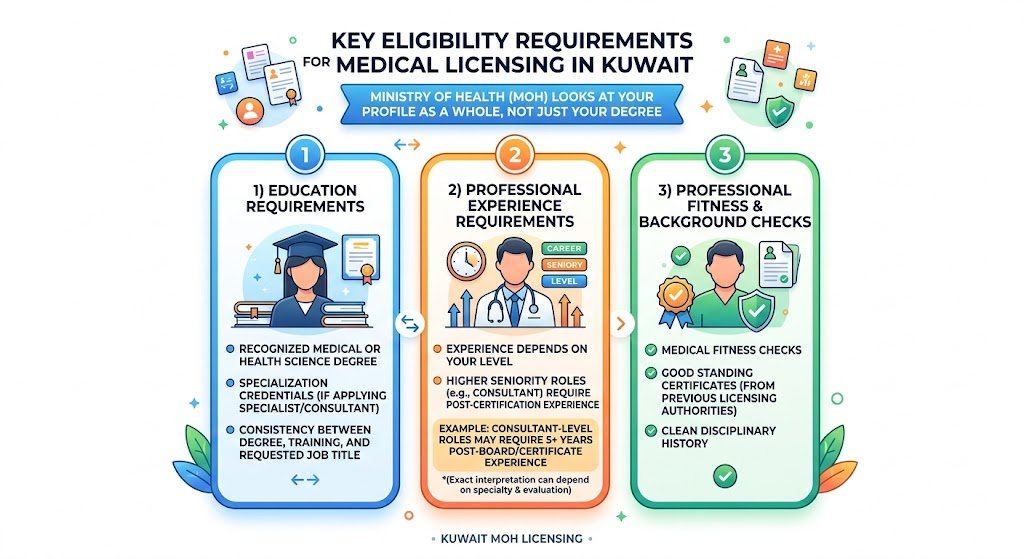
MOH looks at your profile as a whole, not just your degree.
1) Education requirements
- Recognized medical or health science degree
- Specialization credentials (if applying as specialist/consultant)
- Consistency between degree, training, and requested job title
2) Professional experience requirements
Experience requirements depend on your level.
For higher seniority roles (such as Consultant/Senior Consultant), MOH may require a defined period of post-certification experience.
Example requirement often cited in Kuwait hiring/licensing discussions:
- Consultant-level roles may require 5+ years post-board/certificate experience (exact interpretation can depend on specialty and committee evaluation).
3) Professional fitness and background checks
You may be asked for:
- Medical fitness checks
- Good standing certificates (from previous licensing authorities)
- Clean disciplinary history
Licensing rules for doctors in Kuwait (2026 updates and what they mean)
MOH procedures evolve. In recent years, Kuwait has tightened private practice regulation and documentation standards.
Here are key themes you should understand (wording and enforcement can vary by case):
| Regulation theme | What it means for you |
|---|---|
| Government service expectations | Some pathways may prioritize or require government service before certain private practice options |
| Qualification recognition | Your degree and specialty must be approved and verifiable |
| Licensing committee review | Files are evaluated, not automatically approved |
| Continuing education | Ongoing professional development may be expected for renewals/levels |
| License renewal and transfer rules | Changing employers or renewing may require updated documents |
| Practice outside official hours | Rules may apply for additional practice or part-time arrangements |
| Cancellation and disciplinary rules | Licenses can be suspended or revoked under defined conditions |
If your plan is “arrive first, figure it out later,” Kuwait is not forgiving with licensing. Plan the file early.
Kuwait medical license online verification (how it works)
Hospitals and clinics typically verify a professional’s licensing status before final hiring or credentialing.
Verification commonly checks:
- Registration or license number
- License validity/expiry status
- Specialty/category
If you’re already licensed and switching employers, verification is usually part of onboarding.
Common challenges (and how you avoid them)
I’ll be direct: most licensing delays are not because MOH is “slow,” but because files arrive incomplete or inconsistent.
1) Document attestation delays
Degrees and experience letters often get stuck because:
- wrong stamp sequence
- missing embassy authentication
- mismatched names (spelling differences across passport and certificates)
Fix: Make sure your name format is consistent everywhere (English spelling especially). If not, prepare a supporting letter or legal proof of name variation.
2) EPIC verification takes time
EPIC timelines depend heavily on your university’s responsiveness.
Fix: Start EPIC early and follow up with your institution proactively.
3) Prometric timing
People delay Prometric, then wait weeks for scheduling.
Fix: If your category requires it, schedule Prometric as soon as you’re eligible.
4) Employer sponsorship and internal HR delays
Some employers are excellent; others are learning.
Fix: Ask one person to be your single point of contact in HR/licensing, and keep a shared checklist with document status.
Estimated timeline (realistic expectations)
Every case is different, but here’s a practical planning table:
| Stage | Best case | Common case | Slow case (with issues) |
|---|---|---|---|
| Document collection + attestation | 2 to 4 weeks | 1 to 3 months | 3+ months |
| EPIC verification (if required) | 2 to 6 weeks | 1 to 3 months | 3+ months |
| Prometric scheduling + results | 1 to 3 weeks | 3 to 6 weeks | 2+ months |
| MOH review + interview | 2 to 4 weeks | 1 to 2 months | 2+ months |
Planning tip: If you’re aiming to start work on a specific date, work backwards at least 3 to 4 months, especially for expat applications.
Contact: Kuwait MOH Medical Licensing Department
If you need official confirmation for your case:
- Email: license@moh.gov.kw
- Phone: 25753392, 25753386, 25745353, 25721543
- Working hours: Sunday to Thursday, 8:00 AM to 2:00 PM
- Online portal: https://medlic.moh.gov.kw
Final thoughts (from my experience)
If you take one thing from this guide, let it be this: the Kuwait medical licensing process is very doable, but it’s document-driven. When your file is clean, verified, and consistent, everything becomes smoother.
If you are an expat, don’t underestimate how long verification and attestation can take. And if you are in Kuwait, don’t assume that “I can visit the office and fix it in one day.” In many cases, the fastest route is still preparing the correct documents upfront and letting your employer submit properly through MOH systems.
FAQs
How long does it take to get a medical license in Kuwait?
It can take weeks to several months, depending on document attestation, EPIC (if required), Prometric scheduling, and interview availability. Most long delays happen due to incomplete or improperly authenticated documents.
Can I apply for a Kuwait medical license online?
Parts of the process can be handled online through MOH systems, but in many cases the application is submitted and managed by your employer sponsor (hospital/clinic).
What documents are required for a medical license in Kuwait?
Commonly required documents include:
authenticated degrees and transcripts
professional license/registration from home country
experience certificates
passport/Civil ID copy
personal photo
EPIC verification report (for many non-Kuwaiti physicians with foreign basic degrees)
MOH may request additional documents depending on your profession and level.
Do expat doctors need a Kuwait medical license?
Yes. Kuwaiti and non-Kuwaiti healthcare professionals must hold a valid MOH license to work legally in Kuwait.
What is the Prometric exam for Kuwait MOH licensing?
The Prometric exam is a professional competency exam required for many healthcare categories. It is taken at Prometric test centers worldwide, and results are used as part of MOH licensing evaluation.
How much does the medical license cost in Kuwait?
Fees often fall in the 25 KWD to 50 KWD range depending on category, though some applicants may have different fee handling through employers or exemptions.