Kuwait Bus Route Numbers (2026): Full List of Routes, Fares, and How to Use Them
I’m Saleh Muhammad, a Kuwaiti citizen, and I’ve been living outside Kuwait for over 10 years. During that time, I’ve had to rely on public transport in different countries, and I’ve also helped friends and family inside Kuwait figure out buses when they were stuck, late for work, or new to an area.
So in this guide, I’m going to walk you through Kuwait bus route numbers in a simple, real-life way. You’ll get the full list of commonly used routes (with the same route numbering you’ll see on the road), how the numbering works, what “A” and “X” usually mean, average fares, and practical tips I wish someone told me earlier.
If you’re an expat, a student, or even a Kuwaiti who just doesn’t use buses often, this page is written for you.
Quick way to find the right bus (my method)
Before you scroll the full table, do this:
- Identify your start area and the nearest big hub name on the stop (examples: Mirqab, Maliya, Sharq, Hassawi, Jleeb, Farwaniya).
- Pick 1 or 2 route numbers that match your direction from the route tables below.
- Confirm the end stop with the driver (or a regular passenger) before you pay.
- Track landmarks, not “stop names” because drivers often do not announce stops.
If you tell me your start and destination (example: Salmiya to Airport), I can usually narrow it down to 1 to 3 best options.
Understanding Kuwait bus route numbers (in plain language)
In Kuwait, public buses are identified mainly by route numbers, not route names.
A bus number equals a specific path. For example, a route might start in Kuwait City and end in Fahaheel, passing through multiple residential and commercial areas on the way.
Why the route number matters
Route numbers help you:
- Navigate quickly without needing Arabic stop names
- Recognize the same line across multiple operators
- Find consistent paths to key areas like Salmiya, Farwaniya, Hawally, Fahaheel, and Jahra
What “A” and “X” usually mean
You’ll see variations like 21 and 21A or 66 and 66X. In most cases:
| Label | What it usually means | What you should expect |
|---|---|---|
| A | Alternate variant | Slightly different streets or an extra area served |
| X | Express | Fewer stops, faster trip, sometimes higher fare |
Important note: Different operators can run the same route number with small differences (stops, frequency, where exactly it starts). Always confirm the direction and endpoint.
Main bus companies in Kuwait (who actually runs these routes)
Kuwait’s public bus network is mainly served by:
- Kuwait Public Transport Company (KPTC)
- CityBus Kuwait
- KGL Mowasalat
From what I’ve seen, the same bus number often follows a similar “idea” of a route across companies, but details can change:
- Frequency can differ a lot
- Some companies stop more often
- Ticketing and fare handling can be slightly different
So the smart move is to treat the route number as your starting point, then confirm the endpoint before boarding.
Full list of Kuwait bus route numbers (2026)
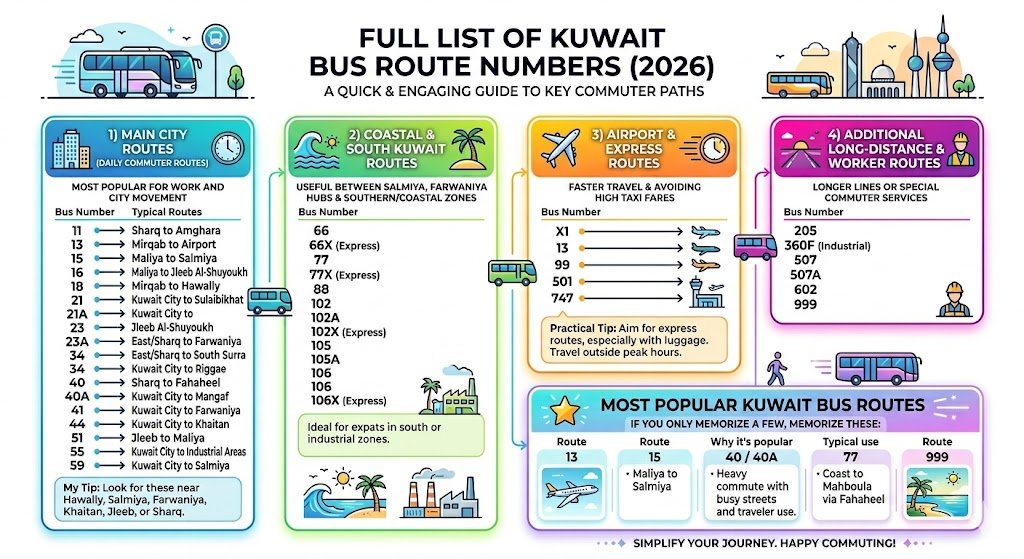
Below is a practical list of commonly used Kuwait bus route numbers and their typical paths.
1) Main city routes (daily commuter routes)
These are the routes most people use for regular work and city movement.
| Bus Number | Typical Route |
|---|---|
| 11 | Sharq / Kuwait City to Amghara |
| 13 | Mirqab to Airport |
| 15 | Maliya to Salmiya |
| 16 | Maliya to Khaitan to Jleeb |
| 18 | Mirqab to Hawally to UN Circle |
| 21 | Kuwait City to Abbasiya |
| 21A | Kuwait City to Farwaniya |
| 23 | East / Sharq to Farwaniya |
| 23A | East to PACI South Surra |
| 34 | Kuwait City to Riggae |
| 40 | Sharq to Fahaheel |
| 40A | Fahaheel to Kuwait City via Mangaf and Mahboula |
| 41 | Kuwait City to Farwaniya |
| 44 | Kuwait City to Khaitan |
| 51 | Jleeb to Maliya |
| 55 | Kuwait City to industrial areas |
| 59 | Kuwait City to Salmiya |
My tip: If you live anywhere near Hawally, Salmiya, Farwaniya, Khaitan, Jleeb, or Sharq, these numbers are the ones you’ll see again and again.
2) Coastal and South Kuwait routes
These are especially useful if you move between Salmiya, Farwaniya-side hubs, and the southern/coastal zones.
| Bus Number | Typical Route |
|---|---|
| 66 | Salmiya to Hassawi (via Farwaniya) |
| 66X | Express Salmiya to Hassawi |
| 77 | Salmiya to Khaitan |
| 77X | Express Salmiya to Shuwaikh to Ardiya |
| 88 | Salmiya to Jaleeb |
| 102 | Maliya to Fahaheel |
| 102A | Maliya to Fahaheel via Mangaf |
| 102X | Express Maliya to Fahaheel |
| 105 | Fahaheel to Hassawi |
| 105A | Jleeb to Fahaheel |
| 106 | Jaleeb to Fahaheel |
| 106X | Express route |
If you’re an expat working in the south or industrial zones, these routes can be your daily backbone.
3) Airport and express routes
Airport routes are the ones people ask me about the most, because taxi fares add up fast.
| Bus Number | Typical Route |
|---|---|
| X1 | Fahaheel to Airport |
| 13 | Mirqab to Airport (regular service) |
| 99 | Airport to Jleeb (via Civil ID) |
| 501 | Mirqab to Airport |
| 747 | Jleeb / Farwaniya to Airport |
Practical tip: If you have luggage, aim for routes that are known to be more direct (often the express ones), and travel outside peak office hours when possible.
4) Additional long-distance and worker routes
These are usually longer lines or special commuter routes.
| Bus Number | Typical Route |
|---|---|
| 205 | Kuwait City to southern areas |
| 360F | Industrial area service |
| 507 | Mirqab to Al Rai to Jleeb |
| 507A | Alternative Jleeb route |
| 602 | Kuwait City to northern districts |
| 999 | Maliya to Salmiya to Fahaheel |
Most popular Kuwait bus routes (what people actually use the most)
If you only memorize a few, memorize these:
| Route | Why it’s popular | Typical use |
|---|---|---|
| 13 | Direct airport access | Kuwait City area to Airport |
| 15 | Heavy commuter demand | Maliya to Salmiya |
| 40 / 40A | Connects city to the south | Sharq to Fahaheel (and back via coastal areas) |
| 77 | Links dense residential areas | Salmiya to Khaitan |
| 999 | Long coastal connection | Maliya to Fahaheel via Salmiya |
These routes typically pass through places like Hawally, Riggae, and Khaitan depending on the variant and operator.
How to use Kuwait bus routes step by step (simple and realistic)
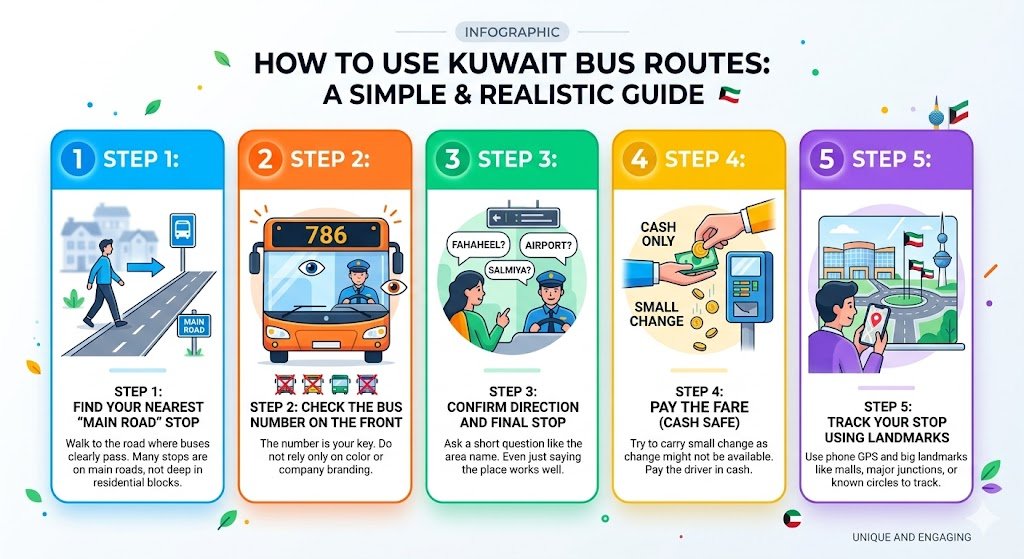
Step 1: Find your nearest “main road” stop
In Kuwait, many useful stops are on main roads, not deep inside residential blocks. Walk to the road where buses clearly pass.
Step 2: Check the bus number on the front
Do not rely on color or company branding only. The number is your key.
Step 3: Confirm direction and final stop
Ask a short question like:
- “Fahaheel?”
- “Airport?”
- “Salmiya?”
Even if you only say the area name, the driver usually understands.
Step 4: Pay the fare (cash is the safest assumption)
In many cases, you pay the driver in cash. Try to carry small change because change is not always available.
Step 5: Track your stop using landmarks
Use big landmarks (malls, major junctions, known circles) and phone GPS if needed.
Average bus fares in Kuwait (what you should budget)
Bus fares are one of the cheapest ways to move around Kuwait compared to taxis and ride-hailing, especially if you commute daily.
Here’s a practical fare range you’ll commonly hear and see:
| Route type | Estimated fare range |
|---|---|
| Short distance | 0.250 KWD |
| Medium route | 0.300 to 0.350 KWD |
| Long route | Around 0.350 KWD |
| Airport express (some lines) | Can reach around 1.000 KWD |
Important: Fares can vary by operator and by route type (regular vs express). If you’re a student, ask if any discount applies on your specific line.
Key areas connected by Kuwait bus routes (what connects to what)
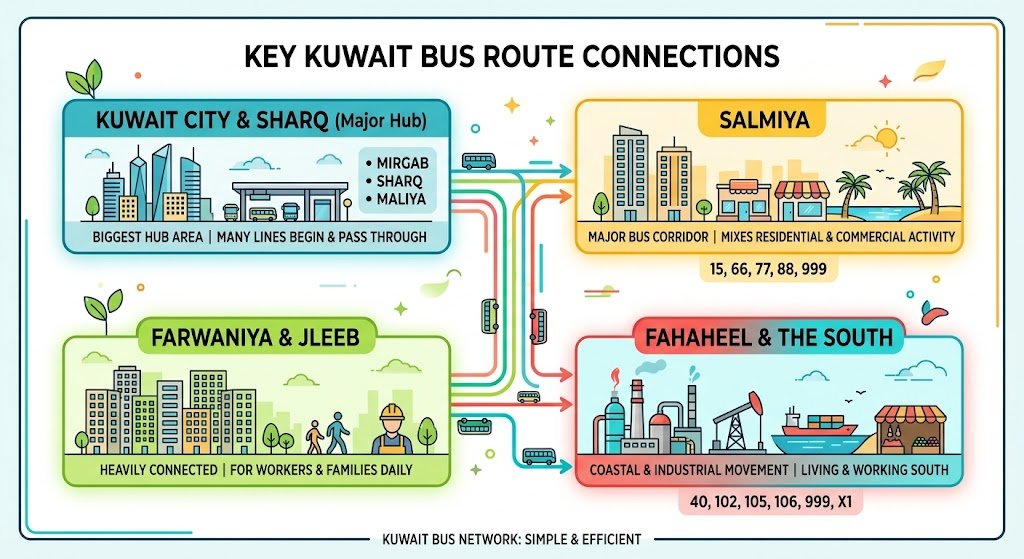
Kuwait City and Sharq
This is the biggest hub area. A lot of lines begin or pass through Kuwait City, Mirqab, Sharq, and Maliya.
Salmiya
Salmiya is a major bus corridor because it mixes residential demand with commercial activity. Routes like 15, 66, 77, 88, and 999 are commonly associated with Salmiya connections.
Farwaniya and Jleeb
These areas are heavily connected by multiple routes because many workers and families depend on buses daily.
Fahaheel and the South
Fahaheel is a key destination for coastal and industrial movement. Routes like 40, 102, 105, 106, 999, and X1 matter a lot if you live or work in the south.
Timing, comfort, and what to expect (real-world bus behavior)
Buses can be reliable in the sense that they exist and run daily, but they are not always timetable-perfect.
Typical peak hours in Kuwait (practical guide)
From my experience and what most commuters follow:
| Time window | What it feels like | What you should do |
|---|---|---|
| 7 AM to 9 AM | Crowded, slower traffic | Arrive early, expect full seats |
| 1 PM to 3 PM | Mixed, depends on area | Usually manageable |
| 4 PM to 7 PM | Very busy | Add extra time, avoid tight schedules |
| After 10 PM | Less frequent | Have a backup plan |
If you have a flight, do not cut it close. Always leave extra buffer time for traffic and waiting.
Safety and travel tips (what I personally recommend)
Public buses in Kuwait are generally safe, but you’ll have a much better experience if you follow a few rules:
- Carry small cash
Many drivers won’t have change, especially during busy hours. - Sit smart if you have a bag
Keep valuables close and avoid placing phones or wallets in loose pockets. - Do not assume stops are announced
Watch the road, use GPS, or ask someone to tell you when your area is coming. - Avoid last-minute airport trips
If the airport is your destination, plan for traffic and possible waiting time. - If you’re new, ask one simple question
In Kuwait, asking “This go Salmiya?” saves you from 30 minutes of going the wrong way.
Final thoughts
Kuwait bus route numbers are the fastest way to understand public transport here. Once you learn a few core hubs like Mirqab, Sharq, Maliya, Hassawi, Jleeb, Farwaniya, Salmiya, and Fahaheel, the whole system becomes easier.
If you’re commuting daily, buses can save you a lot of money over time, and once you get used to the route numbers, it becomes routine.
I wrote this as someone who is Kuwaiti, has lived outside Kuwait for years, and understands what it feels like to be new to a transport system. If you want, tell me your start point and destination and I’ll help you narrow down the best route numbers.
FAQs
What are the main bus companies in Kuwait?
The main operators are KPTC, CityBus Kuwait, and KGL Mowasalat. They often run overlapping route numbers, but stops and frequency can vary.
How much does a bus ride cost in Kuwait?
Most city rides are commonly around 0.250 to 0.350 KWD depending on distance and route type. Some airport express lines can cost more, sometimes up to around 1.000 KWD.
Are Kuwait buses good for daily commuting?
Yes, especially on popular corridors connecting Kuwait City, Farwaniya, Salmiya, Khaitan, and Fahaheel. Just plan around peak hours.
Do Kuwait buses run late at night?
Many routes run from morning to late evening, but frequency often drops after around 10 PM. If you’re traveling late, check your options early or keep a backup like a taxi.
How can I confirm I’m taking the correct route?
Check the route number on the bus front, then confirm the endpoint with the driver by saying the area name. If you’re unsure, ask a passenger who looks like a regular commuter.