Kuwait Computer Test (QMC) in Kuwait: Format, Practice MCQs, Booking and How to Pass
I’m Saleh Muhammad, a Kuwaiti citizen, and I’ve been living outside Kuwait for more than 10 years. That experience made me very practical about paperwork and government processes because when you’re an expat, you learn quickly that small mistakes cost you time. On KuwaitExpat.com, I write the kind of guide I wish I had when I was figuring things out from abroad.
If you’re preparing for the Kuwait computer test, also known as the QMC theory test, this page will walk you through the real exam flow, what to study, how to book, what to bring, and how to practice in a way that actually improves your score.
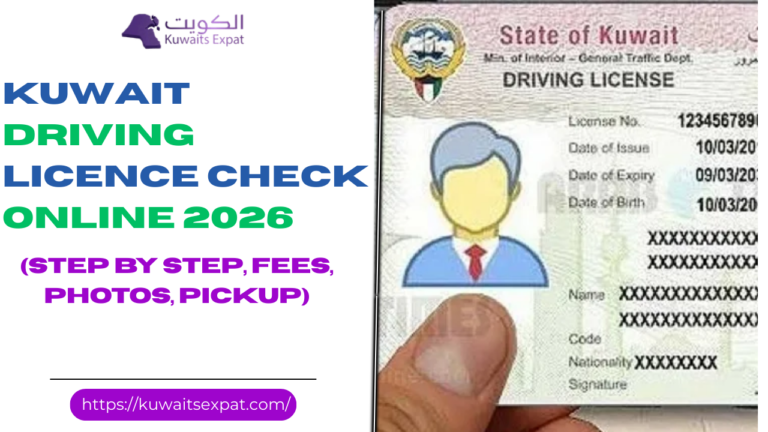
This is the touch-screen multiple-choice test you must pass before you move to the practical driving test.
What the Kuwait Computer Test Covers (QMC Syllabus)
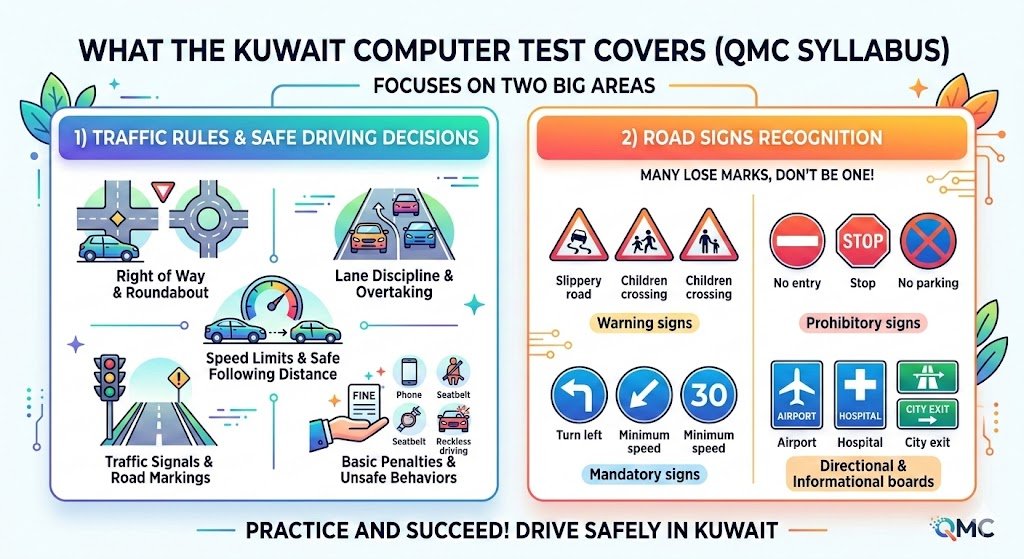
From what candidates consistently see at Traffic Department centers, the QMC focuses on two big areas:
1) Traffic rules and safe driving decisions
You’ll get questions on:
- Right of way at intersections and roundabouts
- Lane discipline and overtaking rules
- Speed limits and safe following distance
- Traffic signals and road markings
- Basic penalties and unsafe behaviors (phone use, seatbelt, reckless driving)
2) Road signs recognition
This is where many people lose marks, especially when two signs look similar. You must know:
- Warning signs (hazards ahead)
- Prohibitory signs (what you must not do)
- Mandatory signs (what you must do)
- Directional and informational boards (exits, services, hospital, parking)
Kuwait Computer Test at a Glance
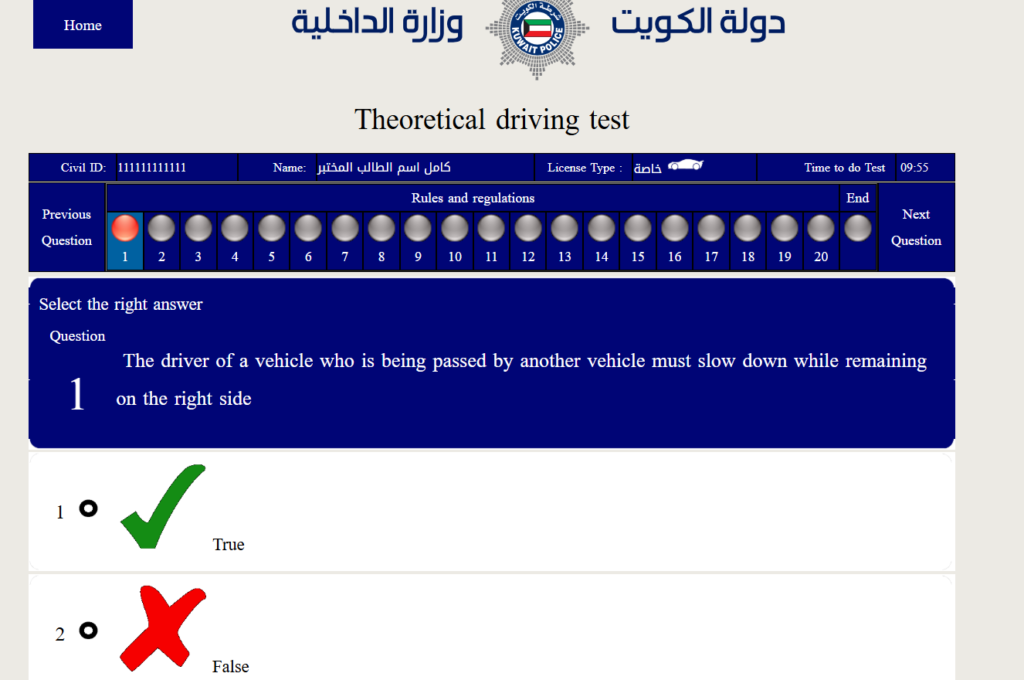
Here’s the simplest summary I give friends before they go:
| Item | What to expect |
|---|---|
| Format | Touch-screen multiple-choice (computer/kiosk) |
| Main topics | Road signs + traffic rules |
| Questions | The official demo commonly shows 20 numbered questions (your center may vary slightly) |
| Time | Short timed session; many finish in under 15 minutes |
| Languages | Arabic, English, Urdu, Hindi (selection appears at the start) |
| Pass mark | Often discussed as 80% to 90% (many candidates report 18/20). Confirm at your test center |
| Retake | Usually possible after a short waiting window, depending on center rules |
Important note: procedures and scoring can be updated. Always follow what the General Department of Traffic staff and booking system display for your appointment.
free QMC mock test (kuwait computer test mcqs)
QMC MOCK TEST
Computer & IT Fundamentals
Practice for the Kuwait / QMC licensing exam with real MCQs covering computer fundamentals, MS Office, networking, internet, and operating systems.
Topics Covered
Performance by Topic
Booking the QMC Theory Test in Kuwait (Where and How)
Most people book through official government channels (commonly through the Traffic Department appointment service and, in many cases, via the Sahel app depending on the current setup).
My practical booking advice
- Book the earliest slot you can, even if you don’t feel ready yet. A date on the calendar makes you study properly.
- If you reschedule, do it early. Last-minute changes can be limited.
Documents to bring (don’t improvise on test day)
Carry:
- Civil ID (original)
- Appointment/booking confirmation (on phone is usually fine, but I recommend a screenshot)
- Payment method if any fee is collected at the center (commonly KNET card)
If your category or file requires extra documents, the center will tell you during verification.
What Happens on Test Day (Step by Step)
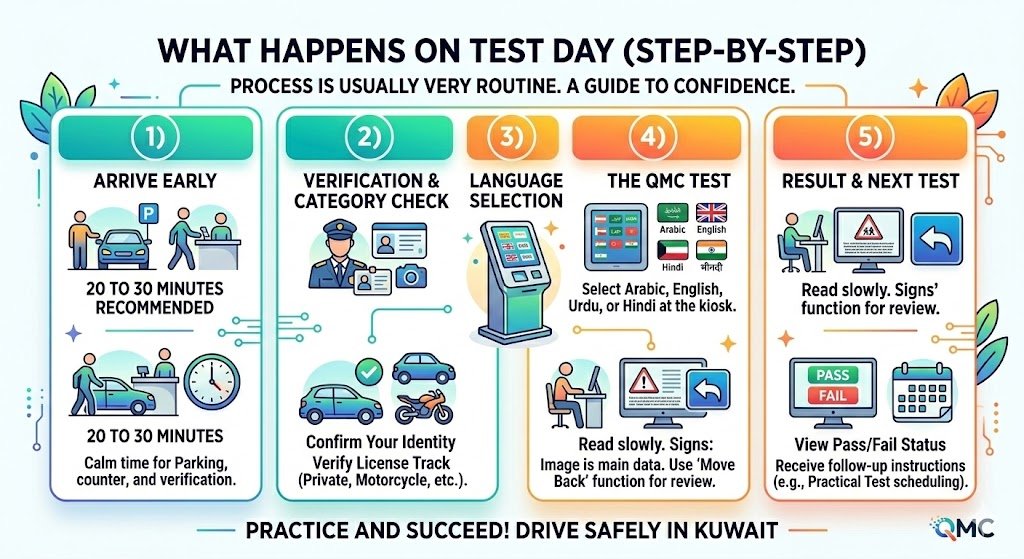
If you’re the type who gets nervous, this section is for you. The process is usually very routine:
1) Arrive early
I always recommend 20 to 30 minutes early. You want calm time for:
- parking
- finding the correct counter
- verification
2) Verification and category check
They verify your identity and confirm your license category (private, motorcycle, etc.). Your test aligns with that track.
3) Language selection
At the kiosk, you select Arabic, English, Urdu, or Hindi at the start.
4) Take the QMC test
- Read every question slowly.
- For sign questions, treat the image as the main data, not the text.
- If the system allows you to move back, use that to review doubtful items near the end.
5) Result and next instruction
After submission, you’ll see pass/fail and what you must do next (often moving toward the practical test scheduling, and sometimes other formal steps depending on your file).
The Smart Way to Practice MCQs (What Actually Works)
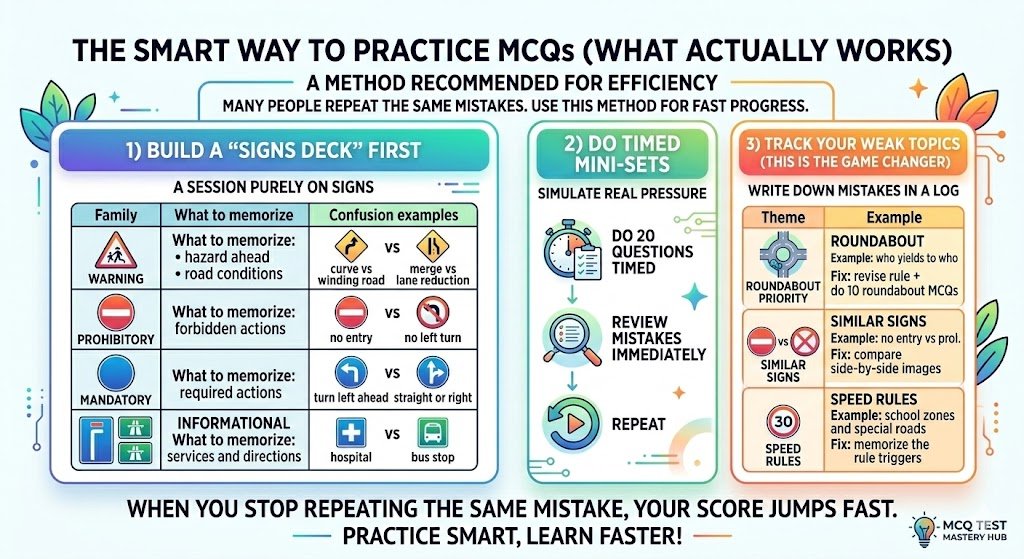
A lot of people do random questions for hours and still fail because they repeat the same mistakes. Here’s the method I recommend because it’s efficient:
Step 1: Build a “signs deck” first
Before heavy MCQs, spend one session purely on signs. Group them like this:
| Sign family | What to memorize | Common confusion |
|---|---|---|
| Warning | hazard ahead, road conditions | curve vs winding road, merge vs lane reduction |
| Prohibitory | forbidden actions | no entry vs no vehicles, no U-turn vs no left turn |
| Mandatory | required actions | turn left ahead vs keep left, straight only vs straight or right |
| Informational | services and directions | hospital vs first aid, parking vs bus stop |
Step 2: Do timed mini-sets
Simulate the real pressure:
- Do 20 questions timed
- Review mistakes immediately
- Repeat
Step 3: Track your weak topics (this is the game changer)
After each set, write down your mistakes in a simple log like this:
| Mistake theme | Example | Fix |
|---|---|---|
| Roundabout priority | who yields to who | revise rule + do 10 roundabout MCQs |
| Similar signs | no entry vs prohibited | compare side-by-side images |
| Speed rules | school zones and special roads | memorize the rule triggers |
When you stop repeating the same mistake, your score jumps fast.
A Practical 5-Day Study Plan (Realistic for Busy People)
If your test is soon, follow this:
| Day | What you do | Target result |
|---|---|---|
| Day 1 | Learn sign families + 30 sign questions | recognize 90% of signs |
| Day 2 | Right-of-way rules + 40 MCQs timed | 70%+ accuracy |
| Day 3 | Signals, lane discipline, speed + 40 MCQs | 80%+ accuracy |
| Day 4 | Mixed set 2 times (20+20) timed + review | stable 85%+ |
| Day 5 | Final mixed set + only weak-topic drilling | aim for 90%+ |
A useful stat you can apply: if the test is 20 questions and you rush, you make avoidable errors. Aim for about 30 to 45 seconds per question on average, and slow down on sign images.
Mini Practice MCQs (Sample Style)
These are original practice questions (not copied from any official pool), designed to train your thinking:
| # | Question | Options | Answer |
|---|---|---|---|
| 1 | A steady red traffic light means | A Go with caution B Stop C Speed up | B |
| 2 | At a roundabout, you usually give way to | A Vehicles entering B Vehicles already inside C Pedestrians only | B |
| 3 | A triangular sign generally indicates | A Mandatory B Warning C Services | B |
| 4 | A circular sign with a red border usually indicates | A Prohibition B Parking C Information | A |
| 5 | If an emergency vehicle approaches with siren | A Maintain speed B Give way safely C Block the lane | B |
| 6 | Solid lane line means | A Overtake anytime B No lane change C Faster lane | B |
| 7 | Safe following distance is important mainly to | A Reduce fuel use B Avoid rear-end collisions C Increase speed | B |
| 8 | Using a phone while driving mainly increases | A Reaction time B Engine power C Tire pressure | A |
| 9 | A “No U-turn” sign means | A U-turn allowed at night B U-turn prohibited C U-turn allowed if road is empty | B |
| 10 | Pedestrian crossing sign means you should | A Speed up B Be prepared to stop C Honk continuously | B |
Use these to warm up, then move to full 20-question timed sets.
Road Sign “Look-Alike” Pairs You Must Master
In my experience helping people prepare, most sign mistakes come from visual confusion, not from “not studying.”
Create a small gallery on your phone of pairs like:
- No Entry vs No Vehicles
- Give Way vs Stop
- Keep Left vs Turn Left Ahead
- Straight Only vs Straight or Right
- Lane Merge vs Lane Reduction
If you review these pairs the night before, your sign accuracy improves noticeably.
If You Fail the Kuwait Computer Test (How to Recover Fast)
Failing happens, and it’s usually fixable quickly if you do this:
- Identify the pattern
Don’t just say “I failed.” Ask yourself: was it signs, roundabouts, speed rules, or signal logic? - Drill only the weak area for 48 hours
Do three short timed sets focused only on that topic. - Rebook as allowed
Retake timing depends on center rules. Follow the instructions given at the test location.
FAQs
How many questions are on the Kuwait QMC computer test?
Many candidates report the official-style interface shows 20 numbered questions. Your exact exam presentation can vary slightly by center, but it’s typically a short set.
What score do I need to pass?
You’ll often hear 80% or 18 out of 20. Because this can differ based on updates and center policy, confirm the required score at booking or check-in.
Can I take the computer test in English?
Yes, the kiosk commonly supports Arabic, English, Urdu, and Hindi, and you choose your language at the start.
What should I bring on test day?
Civil ID, your appointment details, and a payment card if fees are collected at the center.