Kuwait Travel Ban Check

I’m Saleh Muhammad, a Kuwaiti citizen and an expat myself. I’ve lived outside Kuwait for over 10 years, and I’ve had to deal with the same real-life pressure you’re feeling right now. Flights are booked, work is waiting, family is calling, and the question is simple but stressful: Can I leave Kuwait, or is there a travel ban on my Civil ID?
The good news is that in Kuwait today, you can usually confirm your travel ban status in minutes through official government e-services, without guessing and without relying on “someone told me.” In this guide, I’ll walk you through the clearest methods, what the results actually mean, and what to do next if a ban appears.
Important note: I’m sharing practical guidance from experience and official service flows, not legal advice. If your case is criminal or complicated, a lawyer or the relevant authority is the right next step.
Do This Next (Fastest Check in 2 Minutes)
If you’re in a hurry, do this first:
- Open Sahel app
- Go to Services
- Choose Ministry of Justice
- Tap Travel Ban Inquiry
- Review the result and open details if any ban appears
No Sahel access? Use the Ministry of Justice website (Travel Ban Inquiry or Payment of Travel Ban Orders) or the Ministry of Interior portal (Personal Inquiry).
What a Travel Ban in Kuwait Really Means
A travel ban is a legal restriction that prevents you from exiting Kuwait until a specific issue is resolved. It’s typically linked to:
- A financial enforcement case or civil judgment
- An active court matter
- A public prosecution restriction (criminal investigation or complaint)
- Personal status matters (some family-related court rulings)
This is different from immigration issues like residency expiry or overstay fines, although in some situations people confuse the two. Overstay is typically handled through penalties and immigration procedures, while a travel ban is a separate legal “hold” that stops you at the border.
Who issues it, and who enforces it?
In Kuwait, travel bans are commonly recorded through:
- Ministry of Justice (MOJ) systems (courts, enforcement)
- Public Prosecution (criminal complaints and investigations)
And they are enforced at exit points by:
- Ministry of Interior (MOI) border control systems
Why This Matters More Than People Think
Kuwait is home to millions of residents, and expats make up a large share of the population. That means travel, renewals, loans, civil disputes, and employer-related issues are part of daily life. In my experience, many bans are not “dramatic criminal cases” but simple situations like an unsettled financial claim, missed installment, or a case you didn’t even realize was registered.
The biggest mistake I see is people discovering the issue only at the airport. You want to know before you pack.
The 3 Official Ways to Do a Kuwait Travel Ban Check
Quick comparison table
| Method | Best for | What you can see | Typical time |
|---|---|---|---|
| Sahel app (MOJ service) | Fastest check for most people | Active bans, case references, sometimes payment options | 1 to 3 minutes |
| MOJ website (Payment of Travel Ban Orders / Inquiry) | Paying eligible financial bans online | Outstanding amounts, settlement/payment | 5 to 10 minutes |
| MOI portal (Personal Inquiry) | Cross-checking MOI flags | Personal status, some restriction indicators | 5 to 15 minutes |
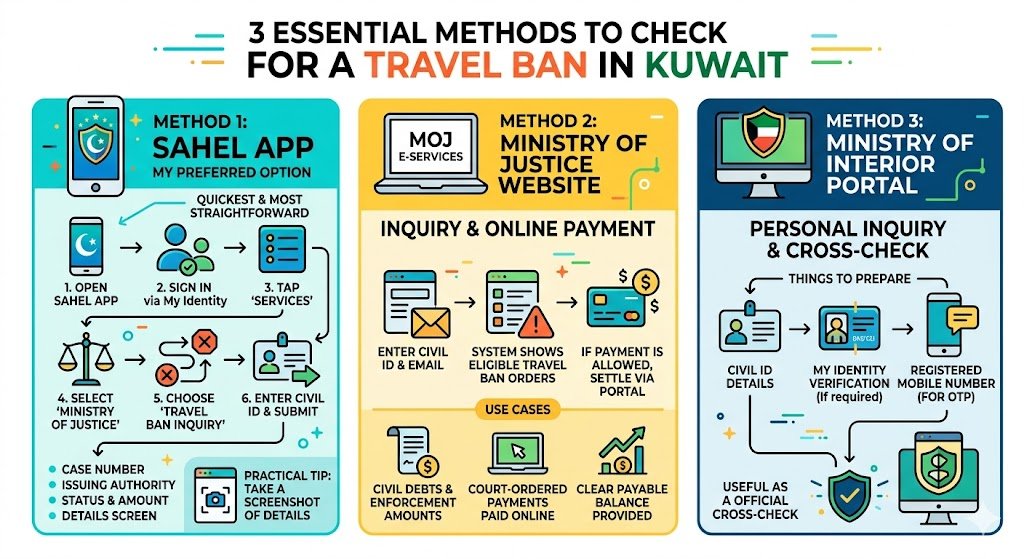
Method 1: Sahel App (My Preferred Option)
If you ask me what I’d use first, it’s Sahel. It’s the quickest and feels the most straightforward for most residents.
Step-by-step: Sahel travel ban inquiry
- Open Sahel
- Sign in (you may be asked to approve using My Identity)
- Tap Services
- Select Ministry of Justice
- Choose Travel Ban Inquiry
- Enter your Civil ID if requested
- Submit and review results
What you’ll usually see if a ban exists
- Case number or reference
- Issuing authority (court or enforcement related)
- Status and sometimes an amount due
- A details screen with next actions
My practical tip: if a ban appears, take a screenshot of the details page and keep it. When you contact any office or support, that case reference saves a lot of time.
Method 2: Ministry of Justice Website (Inquiry and Payment)
If your ban is linked to a financial enforcement order, the MOJ e-services are often where you can resolve it.
How it typically works
- You enter your Civil ID
- You may add an email for receipts
- The system shows if there is an eligible travel ban order tied to payments
- If payment is allowed, you can settle through the portal
When MOJ online payment is most useful
- Civil debts and enforcement amounts
- Court-ordered payments that the system allows to be paid online
- Cases where the portal provides a clear payable balance
If the system does not offer payment options, that usually means your situation requires an in-person process or direct coordination with the relevant authority.
Method 3: Ministry of Interior Portal (Personal Inquiry)
The MOI portal is useful as a cross-check and for other personal status flags that can affect travel. It’s not always as clear as Sahel for MOJ-specific details, but it’s still official and worth using when you want confirmation.
What to prepare
- Civil ID details
- Access to My Identity verification if required
- Your registered mobile number (for OTP)
If a Travel Ban Appears: How to Clear It Step by Step
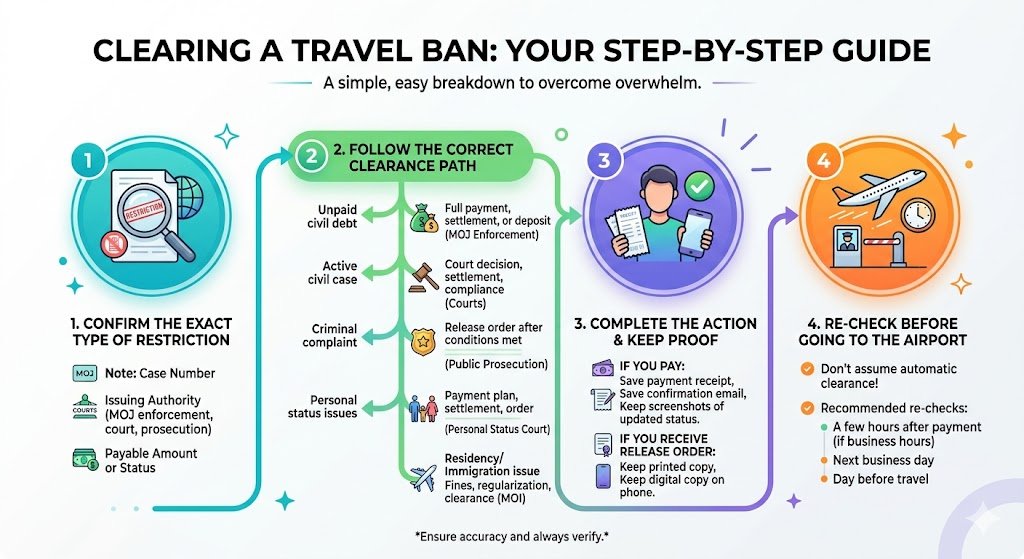
This is where people get overwhelmed, so I’ll break it down simply.
Step 1: Confirm the exact type of restriction
Before you do anything, note:
- Case number
- Issuing authority (MOJ enforcement, court, prosecution)
- Any payable amount or status
Step 2: Follow the correct clearance path
Not all bans are cleared the same way.
Common reasons and what usually clears them
| Reason (summary) | Usually linked to | What typically clears it |
|---|---|---|
| Unpaid civil debt or enforcement | MOJ enforcement | Full payment, court-approved settlement, or deposit if allowed |
| Active civil case | Courts | Court decision, settlement recorded, or judgment compliance |
| Criminal complaint or investigation | Public Prosecution | Release order after conditions are met |
| Personal status issues (family court) | Personal Status Court | Payment plan, settlement, or court order |
| Residency or immigration-related issue | MOI | Fines/regularization and MOI clearance if a hold exists |
Step 3: Complete the action and keep proof
If you pay:
- Save the payment receipt
- Save the confirmation email (if provided)
- Keep screenshots of updated status screens
If you receive a release order:
- Keep a printed copy
- Keep a digital copy on your phone
Step 4: Re-check before going to the airport
This is critical. Don’t assume payment automatically equals clearance at the border.
I personally recommend re-checking:
- A few hours after payment (if during business hours)
- Again the next business day
- And again the day before travel if your flight is soon
How Long Does It Take for a Travel Ban to Lift After Payment?
This depends on the case type and how the clearance is recorded.
Typical timeline (what people commonly experience)
| Clearance action | What usually happens next | Common update window |
|---|---|---|
| Online payment for eligible enforcement amount | System updates once payment posts and case marks satisfied | Same day to next business day |
| Court settlement recorded | Court processing and system update | Often 1 to several business days |
| Prosecution release order | Official lifting and sync to border systems | Varies, sometimes longer |
If you have urgent travel, don’t gamble. Carry your proof, but also make sure the system reflects the clearance before you head to the airport.
What If the Ban Is Not Yours (Name Similarity Issues)
This happens more than people expect, especially with common Arabic names.
If something looks wrong:
- Verify using Civil ID, not just name
- Compare case details and identifiers carefully
- Visit the relevant office (MOJ or MOI) with your documents and request correction or clarification
In my experience, once you have the right case number and your Civil ID, it becomes much easier to prove it’s a mismatch.
Costs, Payments, and Refunds: What to Expect
Costs vary by case, but here’s the practical breakdown.
| Item | Where you’ll see it | Notes |
|---|---|---|
| Claim amount or judgment amount | MOJ enforcement/case details | May require full payment or approved settlement |
| Online processing or service fees | On payment screen | Shown before confirmation |
| Refunds (if case reversed) | Court/treasury process | Timing depends on official procedures and approvals |
My advice: always pay through official channels, and keep every receipt. If anything changes later, your receipts are your protection.
Documents You Should Keep Ready (This Saves Time)
Whenever you’re checking or clearing a travel ban, keep these ready:
- Civil ID (front and back)
- Passport copy (bio page)
- Case number or reference (screenshot helps)
- Any notices or messages you received
- Email address and mobile number used for e-services
- Payment receipts or release orders
My Personal Checklist Before Any Flight Out of Kuwait
If you want a simple routine that prevents airport problems, here’s what I follow and recommend:
- Check Sahel one week before travel (or immediately after booking)
- Check again 48 hours before the flight
- If you paid or settled anything, re-check after processing time
- Keep screenshots and printed proof in your carry-on
FAQs
How can I check if I have a travel ban in Kuwait?
Use one of the official options:
- Sahel app: Ministry of Justice, Travel Ban Inquiry
- MOJ website: travel ban inquiry or Payment of Travel Ban Orders
- MOI portal: Personal Inquiry
All require your Civil ID and verification in many cases.
Can I leave Kuwait if a travel ban is active?
No. If a travel ban is active in the system, you can be stopped at exit control. Clear the issue and confirm it has been lifted digitally before you travel.
How long does it take after I pay to remove the travel ban?
For online payments tied to enforcement orders, many people see updates the same day or next business day. Court and prosecution matters can take longer. Always re-check in Sahel or MOJ before heading to the airport.
Who issues travel bans in Kuwait?
Travel bans are typically issued via courts and enforcement under the Ministry of Justice or by Kuwait Public Prosecution, and they are enforced at borders by the Ministry of Interior.