Kuwaiti Nationality Law 2026 Guide: Eligibility, Loss, and How to Apply
The process of handling family paperwork for newborn registration and marriage documentation and nationality examination reveals that nationality functions as more than a mere identification term. Your nationality determines which educational benefits you receive and how your Civil ID and passport function and whom you can sponsor and which government services you can access.
My name is Saleh Muhammad. I have lived outside Kuwait for more than ten years since becoming a Kuwaiti citizen. My embassy work involved handling registrations and attestations and correcting identity documents and solving “missing link” problems that caused delays for nationality applications. I will explain Kuwaiti nationality law through this guide which uses simple language to present essential aspects of the law that are necessary for daily use.
Important note: I am not the Ministry of Interior and I am not a lawyer. I provide practical process guidance which shows how individuals typically conduct the process. Early legal consultation is necessary for parents who face revocation disputes or complicated cases.
What Kuwaiti nationality law covers (and who runs it)
Kuwaiti nationality rules are primarily based on Emiri Decree No. 15 of 1959. Administration is handled through the Ministry of Interior, specifically the General Directorate of Nationality and Travel Documents. In practice, nationality outcomes often involve committee review and higher level approvals depending on the route.
Who the law applies to
It covers:
- Who is considered Kuwaiti by birth
- How nationality can be acquired (descent, marriage, naturalization, exceptional decree)
- When nationality can be withdrawn or revoked
- What happens if information is incorrect or fraudulent
Kuwait context that explains why this topic is so sensitive
Kuwait has a large expatriate population, and nationality is treated as a high impact legal status.
Here is a commonly reported snapshot based on PACI style population releases in recent years (ranges vary by year):
| Indicator | Commonly reported range |
|---|---|
| Kuwait total population | Around 4.3 to 4.8 million |
| Expat share | Roughly 65% to 70% |
| Citizen share | Roughly 30% to 35% |
Main ways Kuwaiti nationality is acquired
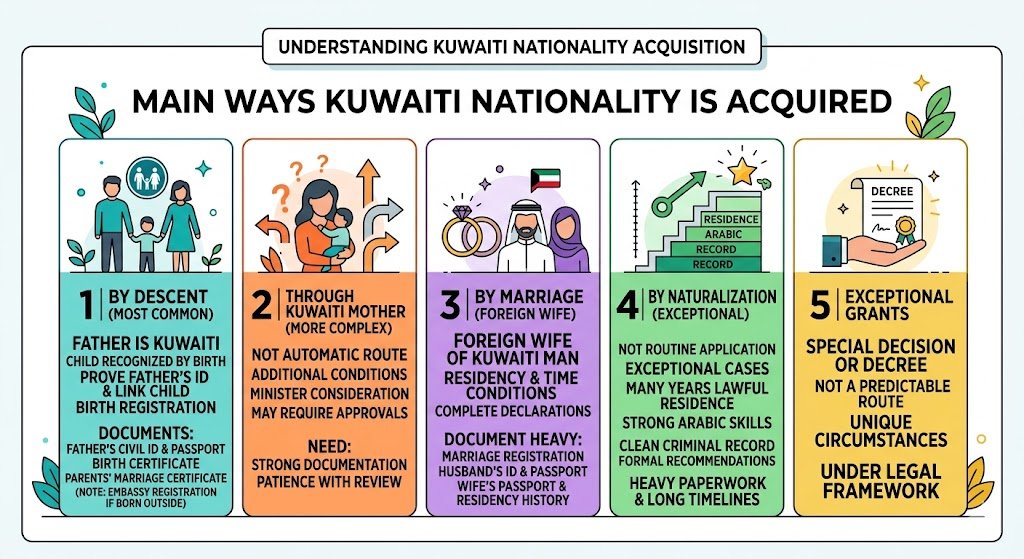
1) By descent (most common route)
In most cases, a child born to a Kuwaiti father is recognized as Kuwaiti by birth. In real paperwork terms, the goal is proving the father’s Kuwaiti identity and legally linking the child to him through official birth registration.
What usually matters in the file:
- Father’s Civil ID and Kuwaiti passport copy
- Official birth certificate showing parent names
- Marriage certificate of the parents
If the child is born outside Kuwait, you normally register the birth through the Kuwaiti embassy or consulate first, then complete the remaining steps in Kuwait.
2) Through a Kuwaiti mother (more complex in practice)
This is where people get confused. The Kuwaiti mother pathway exists as a citizenship path which people can use yet its implementation requires special criteria which need to be approved through ministerial assessment of specific citizen cases.
If you are relying on a Kuwaiti mother route, assume you will need:
- Strong documentation
- Clear explanation of circumstances
- Patience with review timelines
3) By marriage (foreign wife of a Kuwaiti man)
A foreign woman married to a Kuwaiti man may become eligible to apply after meeting residency and time conditions and completing the required declarations and paperwork. The application process requires extensive documentation because most delays in processing originate from this requirement.
Typical documents asked for include:
- Marriage certificate and registration proof
- Husband’s Civil ID and passport copies
- Wife’s passport, residency history, and sometimes background documents
- Proof of continued marital relationship (varies by case)
4) By naturalization (long term residents, exceptional)
Naturalization in Kuwait is generally not a routine application like in some Western countries. It is often treated as exceptional and may require:
- Many years of lawful residence
- Strong Arabic ability (often expected)
- Clean security and criminal record
- Stable work history and documentation
- Formal recommendations and approvals
If you are pursuing naturalization, the paperwork burden is heavy and timelines can be long.
5) Exceptional grants by decree
In some circumstances, nationality may be granted by a special decision or decree. For most people, this is not a predictable “application route,” but it is part of how nationality can be granted under the broader legal framework.
Eligibility quick check table (practical view)
Use this as a starting point to understand which route you are likely in:
| Route | Who it fits | How predictable | Common reason for delay |
|---|---|---|---|
| Descent via Kuwaiti father | Child of Kuwaiti father | Usually highest | Missing birth registration steps or document mismatch |
| Kuwaiti mother route | Child of Kuwaiti mother in specific circumstances | Medium to complex | Additional approvals, incomplete evidence |
| Marriage | Foreign wife of Kuwaiti husband | Medium | Timing conditions, incomplete marital documentation |
| Naturalization | Long term lawful residents | Low predictability | Long review cycles and strict evidence requirements |
| Exceptional decree | Special cases | Very case specific | Depends on decision level and documentation |
Step by step: how to start a nationality related application
Because “nationality” files are not all the same, I will keep this practical.
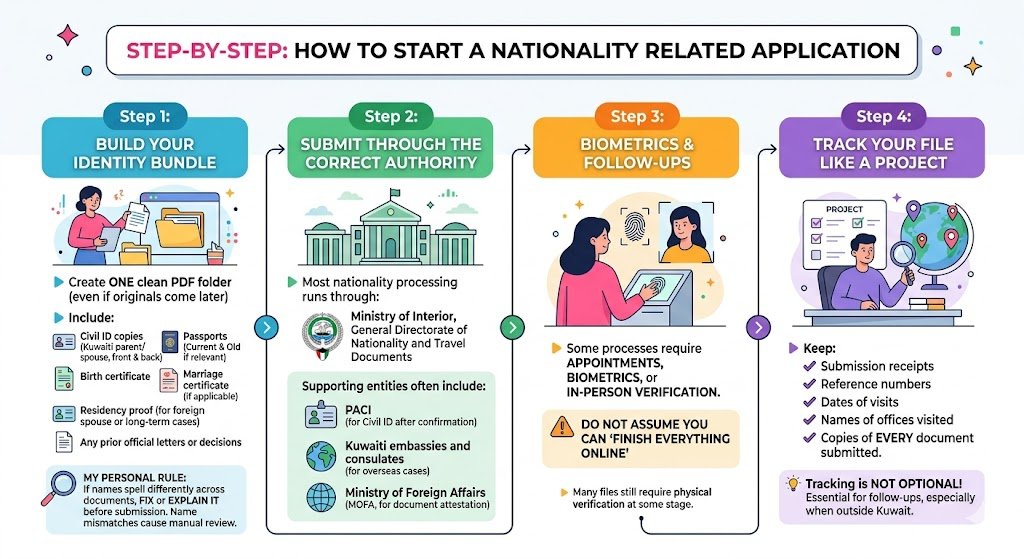
Step 1: Build your identity bundle (this prevents most delays)
I recommend you prepare one clean PDF folder (even if you will submit originals later) with:
- Civil ID copies (front and back) for Kuwaiti parent or spouse
- Passports (current and old if relevant)
- Birth certificate
- Marriage certificate (if applicable)
- Residency proof (for foreign spouse or long term resident cases)
- Any prior official letters, decisions, or case references
My personal rule: if your name appears in two different spellings across documents, fix it or explain it before submission. Name mismatch is one of the biggest reasons files go into manual review.
Step 2: Submit through the correct authority
Most nationality processing runs through:
- Ministry of Interior, General Directorate of Nationality and Travel Documents
Supporting entities often include: - PACI for Civil ID issuance after nationality status is confirmed
- Kuwaiti embassies and consulates for births and documents completed abroad
- Ministry of Foreign Affairs for document attestation where required
Step 3: Biometrics and follow ups
Some processes require appointments, biometrics, or in person verification. Do not assume you can “finish everything online.” Even when an e service exists, many files still require physical verification at some stage.
Step 4: Track your file like a project
Keep:
- Submission receipts
- Reference numbers
- Dates of visits
- Names of offices visited
- Copies of every document submitted
When you are outside Kuwait like me, tracking is not optional. It is how you avoid repeating steps during follow ups.
Timelines and fees (realistic expectations)
Nationality related timelines vary widely. Anyone promising you a fixed duration for every case is not being realistic.
| Item | Typical expectation |
|---|---|
| Descent registration type cases | Often faster if documents are complete |
| Marriage route | Can be lengthy due to conditions and reviews |
| Naturalization | Can take a long time, sometimes years |
| Official fees | Usually nominal for basic services, but confirm current fees through official channels |
| Hidden costs | Translation, attestations, courier, legal consultations |
My advice: budget time more than money. Most of the “cost” is waiting, follow ups, and document corrections.
Loss or revocation of Kuwaiti nationality (what you should know)
This topic requires sensitive handling. The Kuwaiti authorities conducted public discussions in 2024 and 2025 about their review process for nationality files which included cases of alleged fraud and cases with irregular documentation and cases with prohibited dual nationality. Do not handle your case like a standard application when it involves this particular area.
Common grounds discussed in the law and practice
- Fraud or false declarations in the nationality file
- Irregular supporting documents
- Failure to meet conditions attached to a granted status (case dependent)
- Other grounds listed in the law and related procedures
What to do if you are affected
If you receive notice or suspect you are impacted:
- Obtain the official decision details or reference number
- Gather your full historical file (old passports, Civil IDs, family documents)
- Do not rely on rumors or social media summaries
- Get legal advice quickly, especially about timelines and appeal options
- Keep copies of everything and document every interaction
Practical tip from experience: people lose weeks because they cannot produce old identity links. Old passports, old Civil ID copies, and older official certificates matter a lot during review.
Edge cases I see often (and how to avoid problems)
Child born abroad to a Kuwaiti father
What usually works:
- Register birth at the Kuwaiti embassy or consulate promptly
- Ensure the birth certificate shows names exactly as in passports
- Keep attested translations if the certificate is not Arabic or English (depending on requirement)
Different spellings across documents
Fix it early. If you cannot fix it, write a short letter explaining the mismatch and attach supporting proof that shows it is the same person. This small step prevents your file from being paused for identity verification.
Parents not officially married or missing marriage registration steps
These situations can become complicated fast. Do not “try your luck” with incomplete civil status documentation. Get the correct family status documents in order first.
Quick FAQ
Is dual citizenship allowed in Kuwait?
Kuwait generally does not recognize dual nationality in many contexts, and for naturalization routes renunciation of other nationality is often required. The exact implications depend on your specific status and route, so confirm with official guidance for your situation.
How long does naturalization take?
There is no single public fixed timeline. Naturalization is commonly described as exceptional and can take a long time due to reviews and approvals.
Can a Kuwaiti mother pass nationality to her child?
There are pathways, but many cases require additional conditions or ministerial consideration rather than being automatic in every situation. Treat these cases as documentation heavy.
My final checklist before you submit anything
Before you visit the Ministry or the embassy, confirm:
- Names match across passports, Civil IDs, and certificates
- You have copies of old passports if the identity history matters
- Foreign documents are attested and translated if required
- You have a clean one page timeline of events for complex cases
- You are using the correct authority for your route