Residency renewal Kuwait 2026 guide for individuals and companies
I am Saleh Muhammad, a Kuwaiti citizen, and I have been living outside Kuwait for more than ten years. I have spent that period of time renewing my own residency documents while I assisted my family members and helped my friends and readers who needed to complete the same process from overseas. An expatriate can experience a stressful week because of passenger name discrepancies or unpaid penalties that result from minor errors. My goal here is simple: I want you to renew your Kuwait residency smoothly, avoid penalties, and finish the Civil ID renewal the right way.
This guide is written for 2026 procedures as they commonly work through the Ministry of Interior online services, with Civil ID renewal handled after approval through PACI. Rules and fees can change, so I will also show you exactly what to check inside your own MOI account before you pay anything.
What residency renewal means in Kuwait
Residency renewal extends your legal stay in Kuwait under the same residency article. You are not changing your visa type. You are simply extending the validity of the residency already on your file.
In practice, renewal has three parts that must line up:
- Your Kuwait residency is renewed in MOI systems.
- Your health insurance is paid or renewed for the same period.
- Your Civil ID is renewed with PACI after the residency updates.
If you do only the first part and forget PACI, you can still end up with an expired Civil ID, which affects banking, travel, and many daily services. I always tell people to treat Civil ID renewal as part of the same task, not something optional.
Who can renew residency online
In 2026, most residents renew online through MOI e services. This applies to the common residency articles, including:
- Article 18 private sector employees
- Article 17 government employees
- Article 19 investors
- Article 20 domestic workers
- Article 22: Family and dependents
The portal you use depends on who you are:
If you are renewing your dependent, or a domestic worker under your sponsorship, you usually use MOI Individual e services.
If you are an employer renewing employees under Article 18, you use the MOI Companies portal with authorized access.
Before you start, do these three checks
These three checks prevent most renewal failures. I do them every time, even if I am sure everything is fine.
First, check your residency expiry date and fines in MOI.
Second, confirm health insurance is active or ready to be renewed for the same duration you want to renew residency.
Third, confirm the passport validity and the English name spelling in MOI matches the passport exactly.
That last one is important. A lot of people focus on the Arabic name. In reality, Civil ID printing and many system validations depend on the Latin name matching the passport machine readable zone. One extra space or a slightly different spelling can block you later, especially at the Civil ID stage.
Documents and prerequisites you should have ready
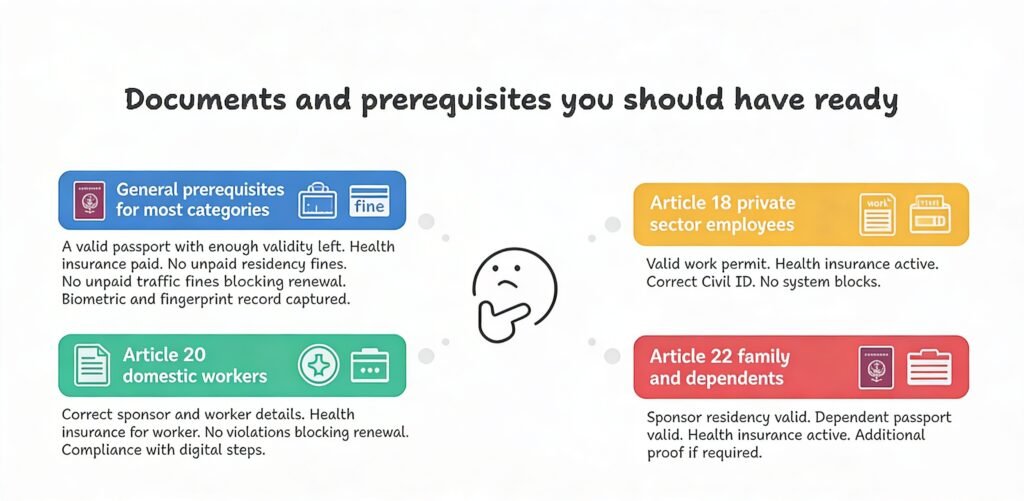
The system is online, but the requirements are still real. When something is missing, the portal may refuse payment or push the file to manual review.
General prerequisites for most categories
- A valid passport with enough validity left. In many cases, you will get smoother results when the passport has at least one year of validity remaining.
- Health insurance paid for the period you plan to renew.
- No unpaid residency fines.
- No unpaid traffic fines that are linked to the file in a way that blocks renewal.
- Biometric and fingerprint record already captured when required.
Article 18 private sector employees
If you are an employee, your company usually manages the process through the Companies portal. What typically needs to be in place:
- Valid work permit and active status with the relevant labor authority workflow.
- Health insurance active.
- Civil ID number is correct and linked properly.
- No system blocks, such as missing biometrics or a compliance flag.
My advice for employees is simple: do not wait for the last week. Start checking 60 to 90 days before expiry, then follow up with your company. Some companies renew fast, others wait until the file opens or until insurance is ready.
Article 22 family and dependents
For spouse and children, you generally need:
- Sponsor residency valid.
- Dependent passport valid.
- Health insurance is active for the dependent.
- For certain ages and cases, additional proof can be required, such as education proof for older children.
If you are sponsoring parents or other relatives, the fees and checks can be different, and the system is stricter. Always review what MOI shows for the dependent category before paying, because the annual fee can change sharply depending on the relationship type.
Article 20 domestic workers
For domestic worker renewal, you typically need:
- Sponsor and worker details are correct in the system.
- Health insurance for the worker.
- No violations that block renewal.
- Compliance with domestic worker rules and any current digitized steps inside MOI and related government apps.
Domestic worker services have become more digital over time, but I still see more edge cases here than in family renewals, mainly because of missing insurance, missing biometrics, or sponsor information not updated.
Fees in 2026 and what to expect
Fees depend on residency status and on the category of dependent. The MOI portal will show the payable amount before you confirm. You should always trust the amount displayed in your account more than any screenshot you find online, because categories and rules are updated.
| Category (examples) | Typical annual fee* |
|---|---|
| Spouse/children of worker (Article 22) | KD 10 per year |
| Other family dependents (e.g., parents or siblings under sponsorship) | KD 200 per year |
| Private-sector employee (Article 18) | As per current MOI schedule (often paid by employer) |
Typical examples people ask me about:
Spouse and children under Article 22 are commonly KD 10 per year per person.
Other family dependents, such as parents, can be much higher, often around KD 200 per year per person, depending on the current schedule.
Article 18 employee renewal fees are commonly handled by the employer and depend on the file.
One important practical point: do not renew health insurance for one duration and residency for another if you can avoid it. Keep the periods aligned. It reduces errors and reduces the chance you have to revisit PACI again due to a mismatched validity.
Penalties and grace rules for late renewal
If your residency expires and you do not renew, fines accrue from the date of expiry. The commonly referenced structure is:
- KD 2 per day for the first month of delay
- KD 4 per day after that
The immigration framework also includes caps and administrative handling that can change, so again, rely on what MOI shows for your file. The key point is this: fines build fast. I have seen people delay because they think they have a grace period. Most of the time, you do not get a free grace period. You get a fine counter.
If your residency is already expired, you can usually still renew online, but you must pay the accrued fines first. My advice is to clear fines and renewal in the same session so you do not forget a step.
Step by step how to renew residency online for individuals
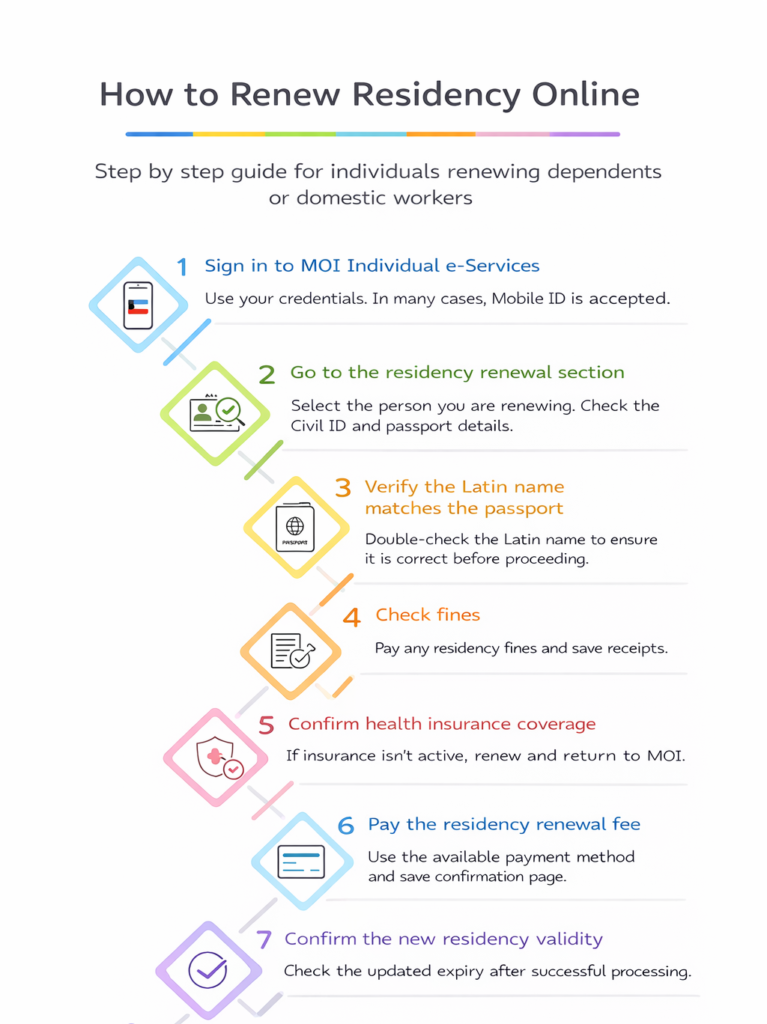
This is the flow I walk people through when they are renewing dependents or domestic workers.
Step 1. Sign in to MOI Individual e-services
Use your credentials. In many cases, Mobile ID is accepted for login and approvals.
Step 2. Go to the residency renewal section
Select the person you are renewing. Check the Civil ID number and passport details.
Step 3. Verify the Latin name matches the passport
Do not rush this. If the name is wrong, stop and fix it through the proper channel before paying, because the issue will come back during Civil ID renewal.
Step 4. Check fines
Pay any residency fines and any other fines the system requires you to clear. Save receipts.
Step 5. Confirm health insurance coverage
If insurance is not active, renew it first. Then return to MOI.
Step 6. Pay the residency renewal fee
Use the available payment method. After payment, save the confirmation page and take a screenshot for your records.
Step 7. Confirm the new residency validity
You should be able to see the updated expiry in MOI after successful processing. Sometimes it is immediate. Sometimes it takes a short time to reflect.
Step by step how to renew residency online for companies
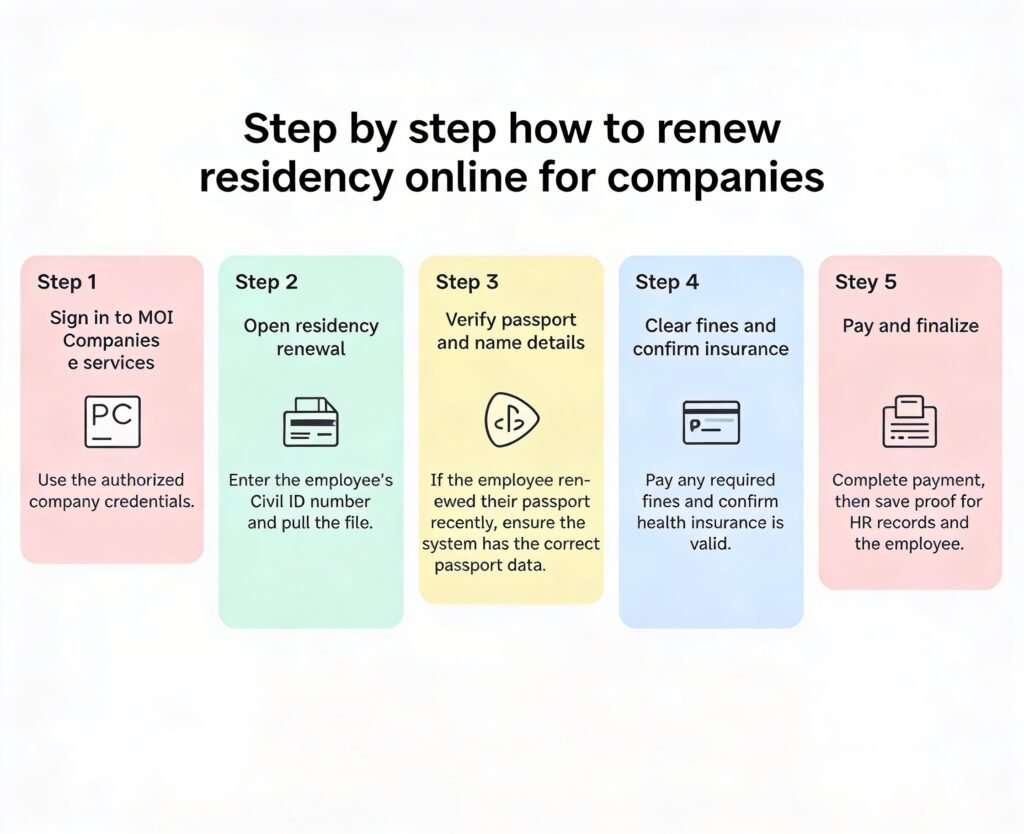
If you are a company renewing an employee under Article 18, the process is similar but inside the Companies portal.
Step 1. Sign in to MOI Companies e services
Use the authorized company credentials.
Step 2. Open residency renewal
Enter the employee’s Civil ID number and pull the file.
Step 3. Verify passport and name details
If the employee renewed their passport recently, this is where problems show up. Ensure the system has the correct passport data.
Step 4. Clear fines and confirm insurance
Pay any required fines. Confirm health insurance is valid and aligned.
Step 5. Pay and finalize
Complete payment, then save proof for HR records and for the employee.
What to do after MOI approval: renew your Civil ID with PACI
Many people stop after MOI renewal and only realize months later that their Civil ID is expired. Do not make that mistake.
Once your residency renewal is approved and updated, renew the Civil ID through PACI services. You will pay the card fee and then track the status for collection or delivery, depending on the available options.
My personal routine is to check PACI status the next day and again after a few days. During busy periods, system updates can lag. If it does not show after a reasonable time, it usually means one of these issues exists:
- The MOI update has not synced yet
- There is a name mismatch
- There is a file block or missing biometric requirement
When can you renew and how early should you start
Most files open for renewal about 30 to 90 days before expiry. It depends on the residency article and on system readiness. I tell readers to start monitoring 90 days before expiry and to be ready to act as soon as the portal allows renewal.
If you are traveling soon, do not gamble on last minute renewal. Airlines and border systems depend on updated residency status, and you do not want to be at the airport with an expired or near expired status and a pending PACI update.
Common problems and how to solve them
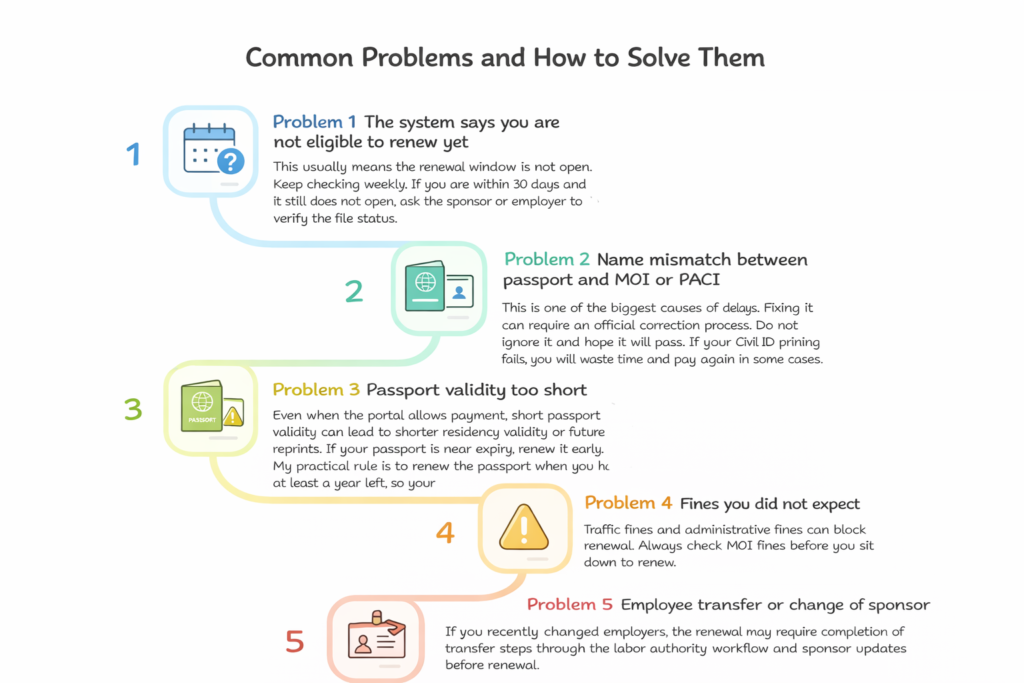
Problem 1: The system says you are not eligible to renew yet
This usually means the renewal window is not open. Keep checking weekly. If you are within 30 days and it still does not open, ask the sponsor or employer to verify the file status.
Problem 2: Name mismatch between passport and MOI or PACI
This is one of the biggest causes of delays. Fixing it can require an official correction process. Do not ignore it and hope it will pass. If your Civil ID printing fails, you will waste time and pay again in some cases.
Problem 3: Passport validity too short
Even when the portal allows payment, short passport validity can lead to shorter residency validity or future reprints. If your passport is near expiry, renew it early. My practical rule is to renew the passport when you have at least a year left, so your next residency cycle is clean.
Problem 4: Fines you did not expect
Traffic fines and administrative fines can block renewal. Always check MOI fines before you sit down to renew.
Problem 5: Employee transfer or change of sponsor
If you recently changed employers, the renewal may require completion of transfer steps through the labor authority workflow and sponsor updates before the MOI renewal becomes available. In these cases, HR timing matters, and you should coordinate early.
Frequently asked questions
How early can I renew my Kuwait residency in 2026?
Most residents can renew around one to three months before expiry. Your MOI account is the final indicator because it shows when your file becomes eligible.
My residency expired. Can I still renew online?
In many cases, yes, but you must pay the late fines first. Fines typically start at KD 2 per day in the first month and increase after that. The portal will show the current fine amount for your file.
Do I need to renew my Civil ID after residency renewal?
Yes. MOI renewal updates your residency status, but you still must renew your Civil ID with PACI to keep your ID valid for daily use.
Where do I check and pay fines?
Inside your MOI e services account. I recommend paying fines and completing renewal in the same session, then saving all receipts.
My final advice as someone who has done this for years
If you take one thing from this guide, let it be this: do not treat residency renewal as a single-click task. Treat it as a short process with checks. Verify expiry, clear fines, align insurance, match passport names, renew residency, then renew Civil ID.
Please provide me with your residency article and the identity of the person whose renewal you are completing, whether they are an employee, spouse, child parent or domestic worker.