Traffic Violation Check in Kuwait
If you drive in Kuwait even occasionally, checking your traffic violations is one of those small habits that saves you a lot of stress later. I’m Saleh Muhammad, a Kuwaiti citizen, and I’ve lived outside Kuwait for over 10 years. During that time I’ve handled renewals, vehicle paperwork, and fines both for myself and for family back home. I know exactly how annoying it is when a simple service gets blocked because of an old fine you didn’t even know existed.
In this 2026 guide, I’ll walk you step by step through the official ways to check traffic violations in Kuwait, how to pay them online, what to do if a fine looks wrong, and how to avoid the most common mistakes I see expats make.
Why you should check traffic fines regularly in Kuwait
In Kuwait, traffic violations are not just “something you pay later.” Unpaid fines can block important services, including:
- Vehicle registration renewal (daftar)
- Driver’s license renewals or updates
- Some Ministry of Interior services linked to your Civil ID
- In certain cases, escalation to legal procedures if ignored too long
My honest advice: make it a monthly habit if you drive often, and always check before any renewal appointment.
Quick comparison: Best ways to check traffic violations (2026)
Here’s the reality. There are 3 main methods most people use, and each one fits a different situation.
| Method | Best for | What you need | Pros | Cons |
|---|---|---|---|---|
| MOI Website (moi.gov.kw) | Full detailed checks | Civil ID or vehicle details | Official, comprehensive | Sometimes slow during peak hours |
| Sahel App | Fast mobile checking + notifications | Kuwait Mobile ID | Easy, secure, alerts | Requires Mobile ID setup |
| MOI App | Checking + quick pay | Kuwait Mobile ID | Direct payment flow | App UI can feel confusing for some users |
If you ask me which one is best for most expats: Sahel is the easiest day-to-day, and MOI website is the best for detailed verification.
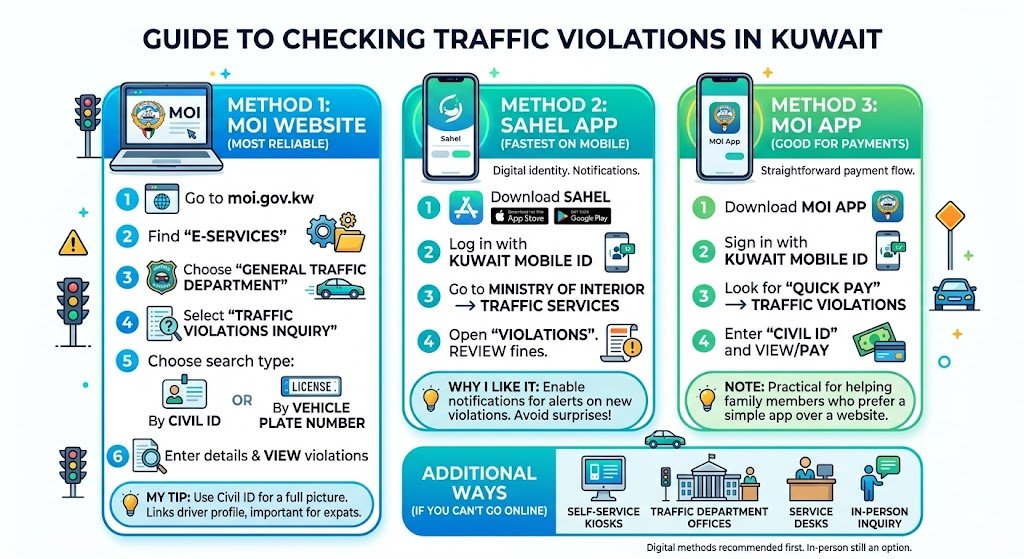
Method 1: Check traffic violations on the MOI website (most reliable)
The MOI portal is still the most “complete” option because it’s the main government source.
Step-by-step (MOI Website)
- Go to the official MOI website: moi.gov.kw
- Find E-Services
- Choose General Traffic Department
- Select Traffic Violations Inquiry
- Choose your search type:
- By Civil ID (best for individuals)
- By Vehicle Plate Number (best if you manage multiple vehicles)
- Enter the required details
- View your violations and fine amounts
My tip from experience
If you use Civil ID, you usually get a more complete picture because some violations can be linked to the driver profile, not only the vehicle. If you’re an expat who drives company cars sometimes, this matters.
Method 2: Check traffic violations using the Sahel App (fastest on mobile)
Sahel has become the easiest option for most residents because it’s built around digital identity and quick government services. If you want notifications when new violations appear, this is the method you should use.
Step-by-step (Sahel)
- Download Sahel from Google Play or the Apple App Store
- Log in using your Kuwait Mobile ID
- Go to:
- Ministry of Interior
- Traffic Services
- Open Violations
- Review your fines and status
Why I personally like Sahel
You don’t have to “remember to check.” If notifications are enabled, Sahel can alert you when a new violation is recorded. That single feature helps you avoid surprises before renewals.
Method 3: Check traffic violations using the MOI App (good for payments)
The MOI App is another official route. Some people prefer it because the payment flow is straightforward once you find the right section.
Step-by-step (MOI App)
- Download the MOI App (Android or iOS)
- Sign in using Kuwait Mobile ID
- Look for Quick Pay (commonly shown in the bottom menu)
- Select Traffic Violations
- Enter your Civil ID
- View and pay violations (if you want)
If you’re helping a family member who isn’t comfortable using websites, the MOI App can be a practical alternative.
Additional ways to check traffic violations (if you can’t go online)
Not everyone has Mobile ID set up, and sometimes apps fail or websites lag. These alternatives can help:
- Self-service kiosks in certain malls or government service centers
- Traffic department offices (in-person inquiry)
- Assistance through service desks in some registration-related locations
I always recommend going digital first, but if you’re stuck, in-person inquiry is still possible.
What information you should prepare before checking
To make your check quick, keep these ready:
| Item | Why it matters |
|---|---|
| Civil ID number | Most complete way to see violations |
| Vehicle plate number | Helps if you’re checking a specific vehicle |
| Kuwait Mobile ID | Required for Sahel and MOI App login |
| KNET card | Needed if you plan to pay immediately |
What to do if you find a traffic fine you didn’t expect
This happens a lot, especially with camera violations.
When you see a fine, don’t just look at the amount. Check:
- Violation date and time
- Location (road name, area, or camera point)
- Violation type or code
- Whether evidence is available (some violations show photo proof)
If you believe the fine is wrong
Your best options are usually:
- File a complaint through the MOI channels (when available)
- Visit the local traffic department to dispute
How to pay traffic violation fines online in Kuwait (2026)
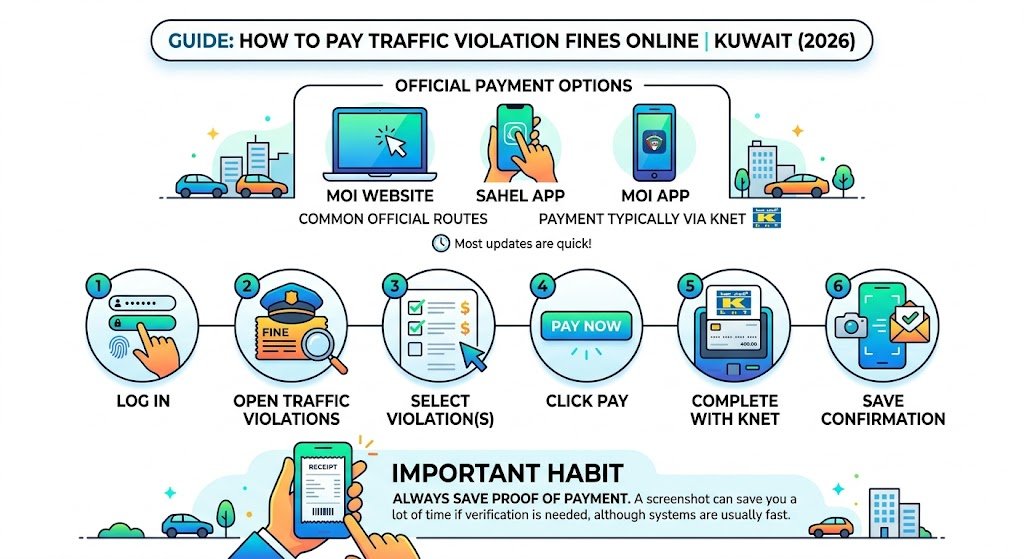
In most cases, online payment is simple and updates quickly.
Payment options (common official routes)
- Pay via the MOI website
- Pay via the Sahel App
- Pay via the MOI App
- Payment typically goes through KNET
Step-by-step: Paying online
- Log in to MOI/Sahel/MOI App
- Open Traffic Violations
- Select the violation(s) you want to pay
- Click Pay
- Complete payment using KNET
- Save your payment confirmation (screenshot + email if available)
Important habit I recommend
Always save proof of payment. Most of the time the system updates fast, but if you ever need to prove you paid, that screenshot saves you a lot of time.
Common traffic violations in Kuwait and typical fine ranges
Fine values can change depending on updates, enforcement campaigns, and case handling. But these are common categories you’ll see often.
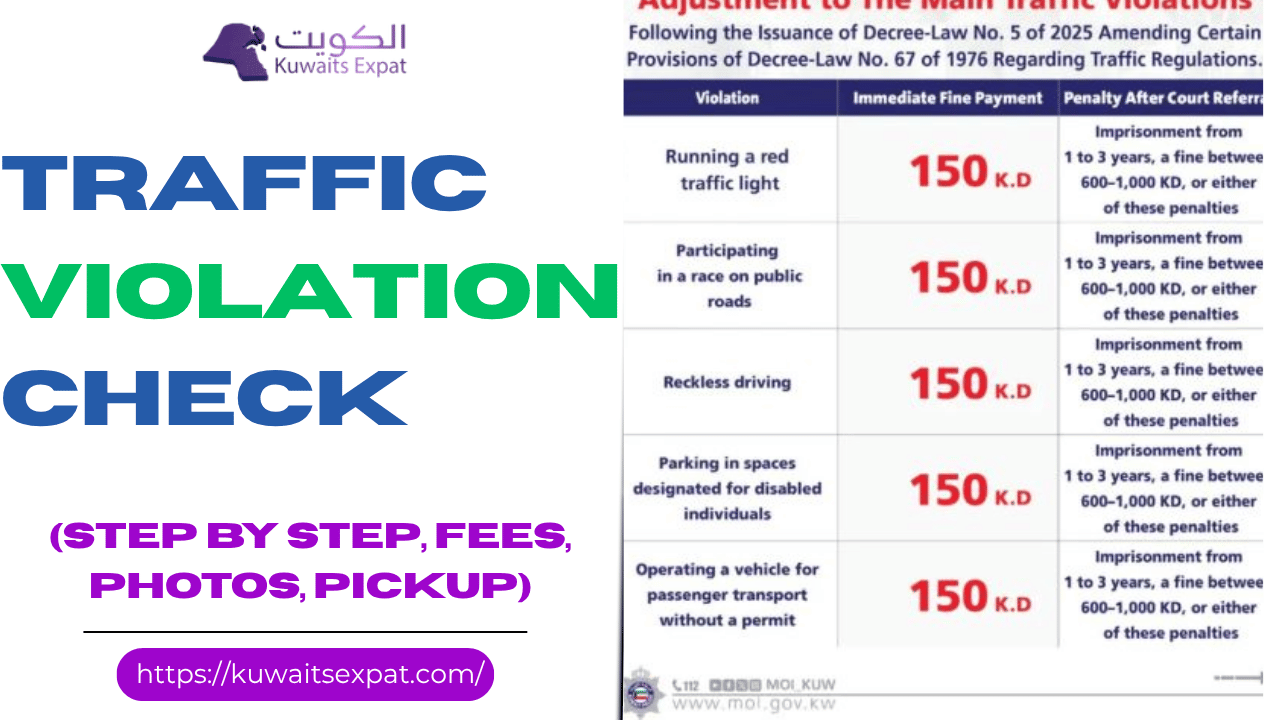
| Violation (common) | Typical fine range in KD | Notes |
|---|---|---|
| Speeding | 20 to 100 | Depends on how far above the limit |
| Using mobile while driving | Around 50 | Often camera or patrol recorded |
| Not wearing seatbelt | Around 10 | Driver and sometimes passenger rules apply |
| Illegal parking | 5 to 20 | Varies by area and signage |
| Red light violation | 100 and above | Often includes stricter consequences |
If you drive daily, speeding and mobile use are the two categories I see hit people most often, especially because camera coverage keeps improving.
Traffic points and license risk (what you should understand)
Kuwait uses a traffic points system for certain offenses. The exact thresholds and consequences can vary by case, but the main idea is simple:
- More serious violations add more points
- Accumulating too many points can lead to serious consequences such as suspension or required procedures
If you’re already sitting on points, be extra careful with repeat offenses like speeding or red light issues because repeat patterns are treated more strictly.
Simple habits that reduce fines (what I personally follow)
I’m not going to give you vague advice like “drive safe.” Here are practical habits that actually reduce violations:
- Use cruise control mindset: stay close to the speed limit, especially on roads you don’t drive daily
- Mount your phone and don’t touch it while moving
- Renew insurance and license early: expired documents create avoidable problems
- Assume cameras are active: because in most major areas, they are
How to contact the Kuwait Traffic Department
If you need help disputing a violation or clarifying a case, use official MOI channels.
Common options include:
- MOI official website support and service listings: moi.gov.kw
- Sahel App support section
- In-person visit to your local traffic department office
Phone numbers and direct hotlines can change, so I always recommend verifying the latest contact details directly on the MOI site or inside Sahel before you go.
Conclusion
Checking traffic violations in Kuwait is easy in 2026 if you stick to official tools. If you want the fastest method, use Sahel. If you want the most detailed verification, use the MOI website. And if you want a direct pay flow, the MOI App works well.
From my own experience as a Kuwaiti who has lived abroad for years and handled these processes repeatedly, the biggest mistake is waiting until the last minute before renewals. If you check regularly, you stay in control and avoid sudden service blocks.
Frequently Asked Questions (FAQs)
Can I check someone else’s traffic violations in Kuwait?
Generally, traffic violations are tied to the Civil ID and/or the registered vehicle. Access usually requires the right identity/login. If you’re helping a family member, do it with their permission and proper credentials.
Can I dispute a traffic fine online?
Some disputes or complaint submissions may be available through MOI channels, depending on the case type. If online dispute isn’t available, you may need to visit the traffic department in person.
Will I see photo evidence for camera violations?
Often, yes, especially for speeding and red-light violations. Availability depends on the violation type and how it was recorded.