Visa 18 Kuwait and Visa 20 Kuwait 2026
I’m Saleh Muhammad, a Kuwaiti citizen, and I’ve lived outside Kuwait for more than 10 years. I’ve gone through the “expat paperwork life” myself in different countries, and I’ve helped friends and family understand Kuwait’s residency and work rules from both sides: as someone who knows how Kuwait works, and as someone who understands how confusing it feels when you’re the one moving.
In Kuwait, people often say “Visa 18” and “Visa 20” like everyone automatically understands. But the difference is huge, and choosing the wrong path can delay your job, your Civil ID, and even your long-term plans (like transferring to a better employer or sponsoring your family).
What Visa 18 and Visa 20 mean in Kuwait
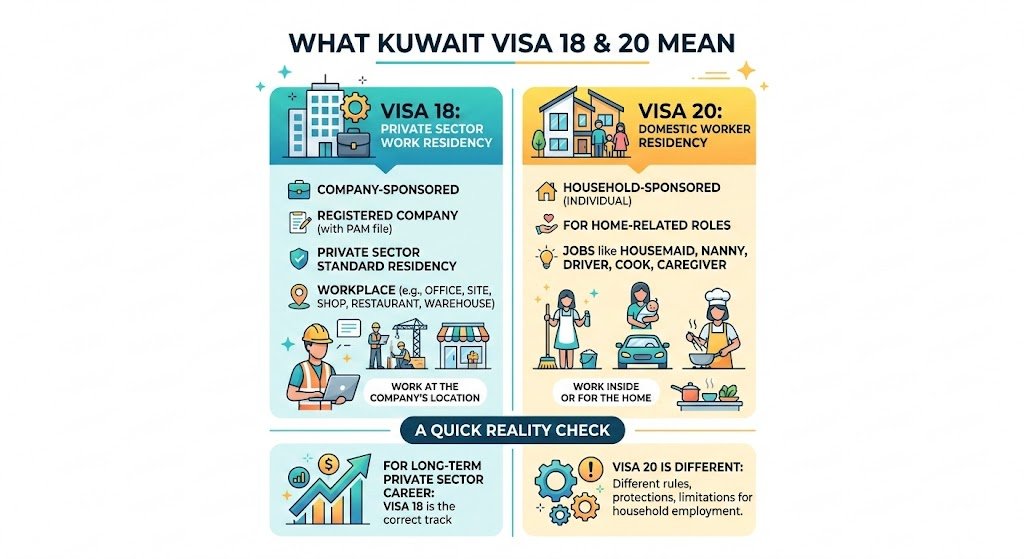
Visa 18: Private sector work residency (company-sponsored)
Visa 18 is the standard residency type for expats working in Kuwait’s private sector. Your sponsor is a registered company that has an active labor file with the Public Authority for Manpower (PAM). You work at the company’s workplace (office, site, shop, restaurant, warehouse, etc.).
Visa 20: Domestic worker residency (household-sponsored)
Visa 20 is for domestic workers sponsored by a household (an individual). These roles are inside or for the home, such as housemaid, nanny, driver, cook, caregiver.
A quick reality check from what I see again and again:
If your goal is a long-term career in Kuwait’s private sector, Visa 18 is usually the correct track. Visa 20 is for household employment and has different rules, protections, and limitations.
Visa 18 vs Visa 20: side-by-side comparison (simple and honest)
| Feature | Visa 18 (Company work) | Visa 20 (Domestic worker) |
|---|---|---|
| Sponsor | Company/employer | Household/individual |
| Where you work | Company sites, shops, offices, projects | Private home / household-related duties |
| Main law framework | Private sector labor system (PAM + labor rules) | Domestic worker regulations |
| Transfer to a new sponsor | Often possible, but depends on rules and approvals | More restricted and tightly regulated |
| Job title and qualification matching | Very important (PAM file, position slot) | Less “degree matching”, more role-based |
| Family sponsorship later | Possible for eligible salary/role (rules apply) | Usually not available |
| Who handles your process | HR/PRO of the company | Sponsor household or recruitment office |
Why the “category” matters more than people think (Visa 18)
When someone tells you “Don’t worry, it’s Visa 18,” my next question is always:
“What’s the job title on the labor file slot?”
In Kuwait, companies don’t just hire freely. They have a labor file with position slots (for example: accountant, sales, driver, technician, barista). Your residency and work permit are tied to that slot, and PAM reviews whether your papers match the job title.
Common Visa 18 job families you’ll see
- Admin and office roles: receptionist, secretary, data entry, HR assistant
- Retail and hospitality: cashier, waiter, barista, supervisor
- Technical roles: electrician, AC technician, mechanic, IT support
- Professional roles: accountant, engineer (often with additional requirements), HSE officer
My personal advice: before you accept an offer, ask the employer to confirm the exact job title they will issue for you. Title mismatches are one of the most common reasons people get stuck.
Step-by-step: how Visa 18 processing usually works (2026)
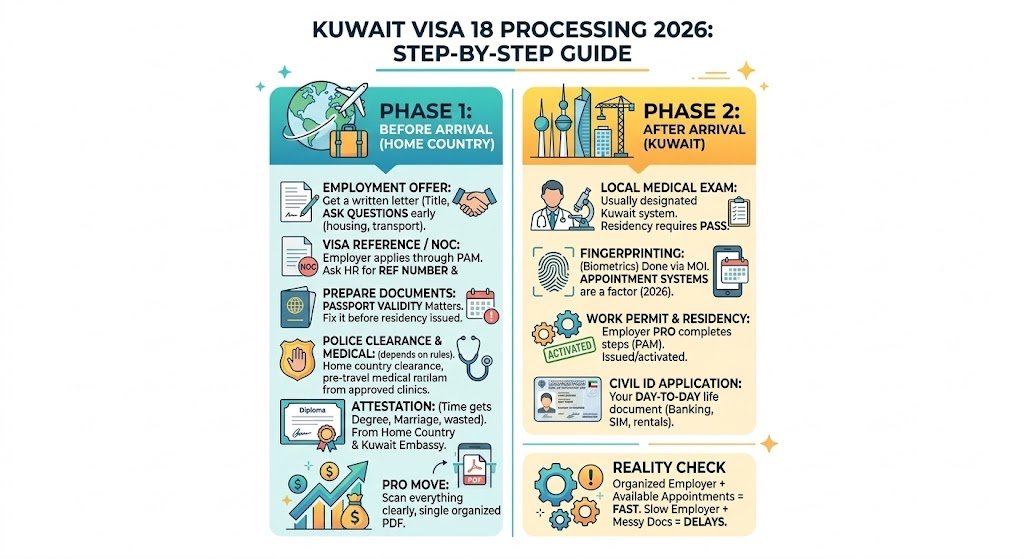
I’ll break this into two phases: before you fly, and after you land in Kuwait.
Phase 1: Before arrival (in your home country)
- Employment offer
- Get a written offer letter with title, salary, and benefits.
- If something is unclear (housing, transport, overtime), ask now, not later.
- Visa reference / work entry approval (what people casually call “NOC”)
- The employer applies through PAM and the Ministry of Interior channels.
- You should ask HR for the visa reference number and your document checklist.
- Prepare your documents
- Passport validity matters a lot. If your passport is close to expiry, fix it before the residency is issued to avoid short validity and extra renewals.
- Police clearance and medical (depending on your nationality and current rules)
- Many cases require a police clearance from your home country.
- Some countries require a pre-travel medical from approved clinics.
- Attestation (this is where time gets wasted)
- Your degree, marriage certificate (if later bringing family), and sometimes experience letters may need attestation from:
- Your country’s relevant authorities
- Kuwait embassy (if required)
- Kuwait Ministry of Foreign Affairs (after arrival, for some documents)
- Your degree, marriage certificate (if later bringing family), and sometimes experience letters may need attestation from:
If you want one “pro move” that saves weeks: scan everything clearly and keep a single organized PDF ready to resend when HR asks again.
Phase 2: After arrival in Kuwait
- Local medical exam
- Usually through the designated medical system in Kuwait.
- Without passing medical, your residency cannot complete.
- Fingerprinting (biometrics)
- Done through MOI processes.
- Appointment availability can affect timing. Kuwait’s government platforms and appointment systems are a real factor in 2026.
- Work permit and residency activation
- Your employer’s PRO/HR completes the work permit steps through PAM and related systems.
- Then residency is issued/activated.
- Civil ID application
- Your Civil ID is your day-to-day life document in Kuwait. Without it, everything becomes harder (SIM cards, banking, deliveries, rentals).
From my experience helping people prepare: when the employer is organized and appointments are available, Kuwait-side steps can move quickly. When the employer is slow or documents are messy, delays multiply.
Document checklist: what sponsors usually ask for
Your documents (prepare these early)
| Document | Why it matters | My tips |
|---|---|---|
| Passport (valid) | Residency is tied to it | Aim for strong remaining validity before stamping |
| Passport photos | Civil ID and residency files | Keep digital and printed copies |
| Degree or trade certificate | Supports job title approval | Attest early if needed |
| Experience letters (optional but powerful) | Helps justify job title | Especially useful when degree doesn’t match |
| Police clearance | Often required | Check validity period and attestation rules |
| Medical reports (if required pre-travel) | Entry and residency | Use only approved clinics if your country requires it |
Employer side (HR/PRO handles this, but you should understand it)
| Employer requirement | What it means |
|---|---|
| Active PAM labor file | Company must be authorized to hire |
| Available position slot | Your “job title category” must exist |
| Clean compliance status | Issues can delay approvals |
| Proper contract and data matching | Name, passport, title, salary must match across systems |
Timelines: realistic expectations (not promises)
Timeframes vary by nationality, document readiness, and appointment availability. But here’s a practical range I’ve seen people experience.
| Stage | Typical range | What causes delays |
|---|---|---|
| Getting documents ready (police, degree, attestations) | 2 to 6+ weeks | Attestation queues, missing stamps, wrong format |
| Visa reference issued by sponsor | 1 to 4+ weeks | Company file issues, slot availability, internal delays |
| Kuwait medical + fingerprints + residency | 1 to 3+ weeks | Appointment availability, failed medical, missing papers |
| Civil ID issuance | 1 to 3+ weeks | Address issues, appointment backlog, data mismatches |
If you want to speed things up, you personally control one big part: document readiness and clean scans.
Renewals, transfers, and job title changes (Visa 18)
Renewals
Your employer usually renews your work permit and residency before expiry. Don’t wait until the last minute. In Kuwait, “last minute” becomes “problem season” very fast.
Transfers to a new employer
Transfers under Visa 18 are often possible, but they depend on:
- Current PAM rules and circulars
- Your contract status
- Approvals and paperwork between the old and new sponsor
I always tell people: don’t resign emotionally before you confirm the transfer process practically. Ask the new employer:
Do you have a slot ready for my exact title, and can your PRO handle the transfer timeline?
Job title change
Title changes can be approved when your documents support it and the company has the right slot. Keep originals of your degree and experience letters. A clean paper trail makes approvals smoother.
Visa 20 specifics (domestic worker): what you must understand
Visa 20 is not “inferior,” but it is a different track. If you’re coming as a domestic worker, you should know what your life structure will look like:
- Your workplace is the household environment
- Your sponsor is an individual
- Transfers are more restricted
- Rules and complaint channels follow domestic worker regulations rather than private-sector labor processes
My honest advice:
If your long-term plan is to build a company career, grow your salary, and potentially sponsor family later, try to start on Visa 18 if your job sector is private company work. Switching tracks later is not always simple.
Useful stats and context (so you understand the environment)
Kuwait is one of the GCC countries where expats form a large share of the total population. Public demographic snapshots over recent years commonly show expats around roughly two-thirds of residents (the exact percentage moves based on government policies and labor market changes).
Why this matters to you:
- Government systems are built around residency categories
- Employers are used to hiring expats, but compliance is stricter than people think
- Correct paperwork is not optional, it is your life stability in Kuwait
Common mistakes I want you to avoid
- Accepting an offer without confirming the job title on the visa slot
- Doing attestations too late (or attesting the wrong document version)
- Flying with a passport that’s near expiry
- Paying “agents” who promise shortcuts without official proof
- Not keeping digital backups of every document and receipt
If you only take one habit from me: keep a single folder with clear scans and shareable PDFs. It saves you stress and weeks of delays.
Quick actions you can take today
| Your situation | Do this next |
|---|---|
| You have an offer but no visa reference | Ask HR for the visa reference and the full checklist in writing |
| Your degree doesn’t match the job title | Share experience letters or request a title that matches your documents |
| Your passport expires soon | Renew it before residency processing |
| You’re confused between Visa 18 and 20 | Decide based on sponsor type: company equals 18, household equals 20 |
FAQs
Is Visa 18 better than Visa 20?
They serve different purposes. Visa 18 is for private-sector company employment and usually offers clearer pathways for career moves and (for eligible cases) family sponsorship. Visa 20 is for household domestic work with its own rules and protections.
Can I switch from Visa 20 to Visa 18?
It can be difficult and is regulated. Some cases may qualify depending on the current rules and approvals. If your goal is company work, it’s usually smarter to start on Visa 18 from the beginning.
How long does Visa 18 processing take?
From what I’ve seen, the slowest part is usually documents and attestations in your home country. Once you’re in Kuwait, medical, fingerprints, residency steps, and Civil ID can move within weeks, depending on appointments and how organized your employer is.
What if my job title changes after I arrive?
It may be possible to update the title if your credentials support it and your employer has the right position slot available. Keep your original documents ready and ensure names and dates match across papers.