Indemnity Calculator Kuwait 2026: End of Service Benefits Guide (EOS)
If you are leaving a job in Kuwait, your end of service benefits (EOS), commonly called indemnity, is not a gift from the company. It is a legal right under Kuwait Labor Law. I am Saleh Muhammad, a Kuwaiti citizen, and I have lived outside Kuwait for more than 10 years. During that time, I have handled my own contracts, resignations, employer disputes, and I have also helped friends and expats understand what they should receive before they sign a final settlement.
In this guide, I will explain indemnity in simple terms, show you exactly how the calculation works in 2026, and help you avoid the common traps that cost people money.
End-of-Service
Indemnity Calculator
Accurate EOS benefit estimates based on Kuwait Labor Law No. 6 of 2010 — for both private sector employees and employers.
Service
What is Labor Indemnity?
Indemnity (End-of-Service benefits) is a legally mandated payment made to employees upon termination of employment in Kuwait. It is governed by Law No. 6 of 2010 and applies to all private sector workers, whether Kuwaiti or expatriate.
It is calculated based on your daily wage, your years of service, and the reason for leaving your position.
How is it Calculated?
Daily Salary = Monthly Salary × 12 ÷ 365
Resignation Deductions
If you resign voluntarily, your indemnity may be reduced:
1–3 years: ½ of normal indemnity.
3–5 years: ⅔ of normal indemnity.
5+ years: Full indemnity.
Example Scenarios
Daily = 600×12÷365 = 19.726 KWD
First 5 yrs: 19.726 × 15 × 5 = 1,479.45
Next 2 yrs: 19.726 × 30 × 2 = 1,183.56
Total ≈ KWD 2,663.01
Daily = 400×12÷365 = 13.151 KWD
3 yrs: 13.151 × 15 × 3 = 591.78 → × ⅔ = −⅓ deduction
Total ≈ KWD 394.52
Frequently Asked Questions
All private sector employees in Kuwait, regardless of nationality, are entitled to indemnity under Law No. 6 of 2010.
Yes — “indemnity,” “EOS benefits,” and “service indemnity” all refer to the same legal entitlement upon leaving employment.
Only legitimate deductions are allowed, such as outstanding salary advances or loans. Social security contributions must not be deducted from indemnity.
Under Article 41 of Kuwait Labor Law, if you are terminated for specific acts of gross misconduct, you may forfeit your right to indemnity entirely.
You can file a complaint with the Ministry of Social Affairs and Labor (PAM). Keep your employment contract and salary slips as evidence.
No. This calculator is for private sector employees only. Government employees are subject to different civil service regulations.
Indemnity is typically calculated on basic salary only, not overtime or allowances, unless your contract specifies otherwise.
Kuwait Indemnity Calculator: What You Need to Enter
To estimate your indemnity, you only need clean, accurate inputs. When you use any Kuwait indemnity calculator (including the one on kuwaitsexpat.com), enter the following:
- Start date
The day you officially joined (as per contract or work permit). - End date
Your final working day (not always the day you submit resignation). - Last monthly remuneration in KWD
Use your last stable pay. Ideally include fixed allowances that are consistently paid (more on this below). - Unpaid leave days
Unpaid leave usually reduces the service period counted for EOS.
After you click Calculate, you will get an estimate. Remember: the final, enforceable amount depends on your exact contract terms, pay structure, and the reason your employment ended.
What Is Labor Indemnity in Kuwait
Indemnity is a lump sum paid to an employee when the employment relationship ends. It applies to private sector employees under Kuwait Labor Law (Law No. 6 of 2010) and related regulations.
It is separate from:
- Your last salary
- Overtime
- Unused annual leave pay
- Notice period pay (if applicable)
- Commissions (if contractually due)
Think of indemnity as the legal “service reward” for the time you gave the employer.
Who Is Entitled to Indemnity in Kuwait
In general, all private sector employees (Kuwaiti and non-Kuwaiti) are entitled to EOS, as long as they meet the legal conditions. Employers cannot simply remove indemnity by policy.
Also important: social security is separate. For Kuwaitis, social insurance rules differ, and for expats there is no Kuwaiti pension, so EOS is usually the main long-service benefit.
The Core Calculation (Kuwait Labor Law 2026)
Kuwait law calculates indemnity based on:
- Your last remuneration (your wage basis)
- Your length of service
- Whether you are paid monthly or on a daily or hourly basis
- Whether you resigned or were terminated
- Whether termination was due to serious misconduct (which can remove entitlement)
Table 1: EOS Indemnity Rate (Private Sector)
| Pay Type | First 5 years | After 5 years | Legal maximum (cap) |
|---|---|---|---|
| Monthly-paid employee | 15 days wage per year | 1 month wage per year | 1.5 years wage (18 months) |
| Daily, hourly, weekly, piece-rate | 10 days wage per year | 15 days wage per year | 1 year wage (12 months equivalent) |
This table alone is a “money saver”, because many people assume everyone gets the same 15 days then 30 days structure. That is common online, but the law separates monthly-paid from non-monthly paid employees.
Daily Wage: The Detail That Changes the Number
To calculate “15 days wage”, you need a daily wage.
In Kuwait, daily wage for monthly-paid staff is often estimated as:
- Daily wage = monthly remuneration / 26 (common payroll working-days method)
Some employers use 30. Courts and dispute outcomes can depend on the contract and payroll practice. For calculator estimates, dividing by 26 is widely used in practice for monthly payroll calculations, but if your contract clearly defines a different method, follow your contract.
My advice: keep both estimates in mind. If the difference is large, it is worth confirming with HR in writing before signing a settlement.
Resignation vs Termination: Your Percentage May Change
This is where many expats lose money. If you resign, Kuwait law can reduce your indemnity depending on how long you worked.
Table 2: Common Resignation Entitlement (Monthly-paid employees)
| Years of service | Indemnity if you resign |
|---|---|
| Less than 3 years | Often not entitled (commonly applied) |
| 3 to less than 5 years | 50 percent of calculated EOS |
| 5 to less than 10 years | 2/3 of calculated EOS |
| 10 years or more | 100 percent of calculated EOS |
If your employer terminates you without fault, you normally receive full EOS (subject to caps). If you are terminated for a serious misconduct case (and it is legally proven), EOS can be reduced or removed.
Step By Step: How to Calculate (Monthly-paid Example)
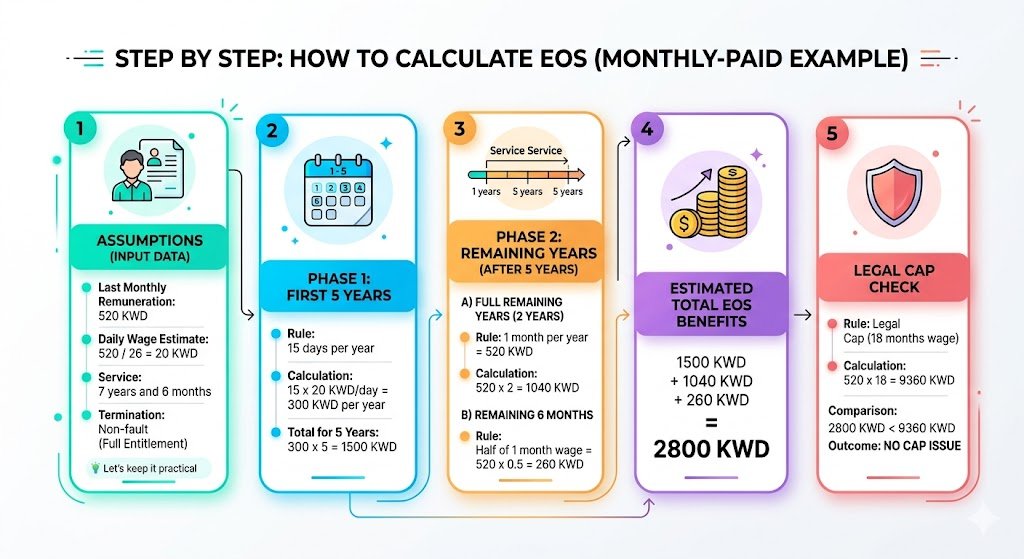
Let’s keep it practical. Assume:
- Last monthly remuneration: 520 KWD
- Daily wage estimate: 520 / 26 = 20 KWD
- Service: 7 years and 6 months
- Termination is non-fault (full entitlement)
- First 5 years
15 days per year = 15 x 20 = 300 KWD per year equivalent
For 5 years: 300 x 5 = 1500 KWD - Remaining years after 5 years
After 5 years, monthly-paid employees get 1 month per year
1 month wage per year = 520 KWD
For 2 full years: 520 x 2 = 1040 KWD - Remaining 6 months
Half of 1 month wage = 520 x 0.5 = 260 KWD
Estimated EOS = 1500 + 1040 + 260 = 2800 KWD
Then check the legal cap (18 months wage).
18 months wage = 520 x 18 = 9360 KWD, so no cap issue here.
Table 3: Quick Example Summary
| Component | Result |
|---|---|
| First 5 years (15 days per year) | 1500 KWD |
| Next 2 years (1 month per year) | 1040 KWD |
| Extra 6 months | 260 KWD |
| Total EOS estimate | 2800 KWD |
Unpaid Leave and Partial Periods
Unpaid leave usually does not count as service time. This means:
- Your “end date minus start date” may not be your legal service duration if you took long unpaid breaks.
- Your EOS calculator becomes more accurate when you enter unpaid leave days.
If you have exact unpaid leave dates, keep them. If you end up in a dispute, documents win cases.
Other Payments You Should Not Forget (People Often Miss These)
Indemnity is only one part of your final settlement. In my experience, the most missed item is unused annual leave.
Useful legal reference point:
- Annual leave in Kuwait private sector is commonly 30 days per year (after completing eligibility conditions under the law).
When you exit, you may also be owed:
- Unused annual leave salary
- Notice period salary (if the employer ends you without proper notice)
- Pending commissions or incentives (if written in contract and earned)
- Reimbursements (if company policy promises them)
Documents Checklist Before You Sign Any Final Paper
Before you sign a clearance or “final settlement” document, make sure you have:
- Work contract and any amendments
- Salary slips for the last 3 to 6 months
- Civil ID copy and work permit details
- Leave balance record
- Resignation email or termination letter
- Any warning letters (if termination is disputed)
If you sign a settlement stating “I received all my dues”, it can become harder to claim later.
If You Think Your Indemnity Is Wrong
Here is what I would do (and what I have guided others to do):
- Ask HR for a written breakdown of the calculation.
- Compare it with the legal formula and your contract wage definition.
- If they refuse or delay, file a complaint with the competent labor authority.
- If the amount is large or the case is complex, consult a labor lawyer. One correct letter can sometimes solve a “no” that HR keeps repeating.
Frequently Asked Questions
What salary should I use for EOS calculation
Use your last remuneration. Usually this includes basic salary and fixed recurring allowances. One-time payments are usually not counted.
Is indemnity mandatory in Kuwait
Yes, it is a legal entitlement for eligible private sector employees. It is not optional for the employer.
Can my employer deduct money from indemnity
Only legitimate deductions can apply, like documented loans or advances. Random deductions are not acceptable.
Do I lose indemnity if I resign
Not always, but your percentage can reduce depending on years of service. After long service, resignation often still gives you a strong entitlement.
What is the maximum indemnity in Kuwait
For monthly-paid employees, the EOS cap is commonly 1.5 years of wage, which equals 18 months of remuneration.
My Personal Advice Before You Leave Kuwait
Do not treat EOS as a “guess”. Treat it like a calculation that must be explained line by line. You worked for it. If you want, share your start date, end date, last monthly remuneration, whether you resigned or were terminated, and whether you are monthly